
From the Bookshelves: Backroads Pragmatists Mexico’s Melting Pot and Civil Rights in the United States by Ruben Flores, Migrants, Money, and Meaning in El Salvador and the United States by David Pedersen
There are two interesting and topical immigratiuon-related books that I preview here today.
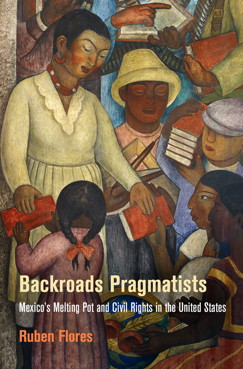
Backroads Pragmatists Mexico’s Melting Pot and Civil Rights in the United States by Ruben Flores
Like the United States, Mexico is a country of profound cultural differences. In the aftermath of the Mexican Revolution (1910-20), these differences became the subject of intense government attention as the Republic of Mexico developed ambitious social and educational policies designed to integrate its multitude of ethnic cultures into a national community of democratic citizens. To the north, Americans were beginning to confront their own legacy of racial injustice, embarking on the path that, three decades later, led to the destruction of Jim Crow.
Backroads Pragmatists is the first book to show the transnational cross-fertilization between these two movements. In molding Mexico’s ambitious social experiment, postrevolutionary reformers adopted pragmatism from John Dewey and cultural relativism from Franz Boas, which, in turn, profoundly shaped some of the critical intellectual figures in the Mexican American civil rights movement. Ruben Flores follows studied Mexico’s integration theories and applied them to America’s own problem, holding Mexico up as a model of cultural fusion. These American reformers made the American West their laboratory in endeavors that included educator George I. Sanchez‘s attempts to transform New Mexico’s government agencies, the rural education campaigns that psychologist Loyd Tireman adapted from the Mexican ministry of education, and anthropologist Ralph L. Beals’s use of applied Mexican anthropology in the U.S. federal courts to transform segregation policy in southern California. Through deep archival research and ambitious synthesis, Backroads Pragmatists illuminates how nation-building in postrevolutionary Mexico unmistakably influenced the civil rights movement and democratic politics in the United States.
Click here for a review of Backroads Pragmatists.
Migrants, Money, and Meaning in El Salvador and the United States by David Pedersen
Over the past half-century, El Salvador has transformed dramatically. Historically reliant on primary exports like coffee and cotton, the country emerged from a brutal civil war in 1992 to find much of its national income now coming from a massive emigrant workforce—over a quarter of its population—that earns money in the United States and sends it home. In American Value, David Pedersen examines this new way of life as it extends across two places: Intipucá, a Salvadoran town infamous for its remittance wealth, and the Washington, DC, metro area, home to the second largest population of Salvadorans in the United States. Pedersen charts El Salvador’s change alongside American deindustrialization, viewing the Salvadoran migrant work abilities used in new lowwage American service jobs as a kind of primary export, and shows how the latest social conditions linking both countries are part of a longer history of disparity across the Americas.
Drawing on the work of Charles S. Peirce, he demonstrates how the defining value forms—migrant work capacity, services, and remittances—act as signs, building a moral world by communicating their exchangeability while hiding the violence and exploitation on which this story rests. Theoretically sophisticated, ethnographically rich, and compellingly written, American Value offers critical insights into practices that are increasingly common throughout the world.
KJ