
U.N.’s New York Declaration on Migrants and Refugees
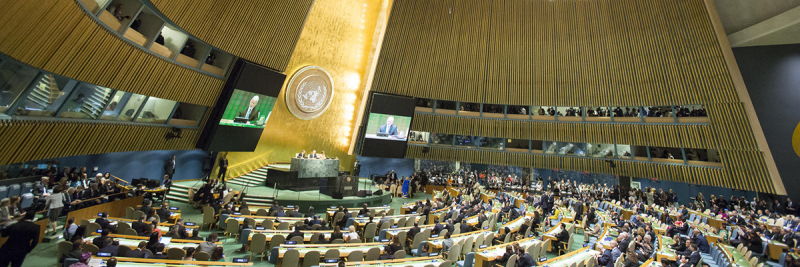
Photo courtesy of United Nations General Assembly website
Huffington Post reports that on 19 September 2016, Heads of State and Government from around the world gathered together in the United Nations and adopted the New York Declaration for Refugees and Migrants, a historic document that seeks to address the urgent questions posed to the international community by the growing global phenomenon of large movements of refugees and migrants.
The New York Declaration has been adopted in the context of the United Nations Summit for Refugees and Migrants, a one-day event organized by the President of the General Assembly of the United Nations on behalf of Member States, and attended by Heads of State and Government, Ministers, and leaders from the UN System, civil society, private sector, international organizations, and academia, among others.
Newsweek summarizes on the challenges in convincing 193 nations to agree on how best to handle the twin problems of migrants and refugees; while refugees already have legal protection and rights under international conventions, there is no such consensus on economic migrants, and many richer countries are resistant to changing that.
The key negotiators of the U.N.’s New York Declaration on Migrants and Refugees were Jordanian Ambassador Dina Kawar—concerned with millions of refugees pouring into Lebanon, Turkey and Jordan from Syria, Iraq, Afghanistan and Africa—and Irish Ambassador David Donoghue, whose primary focus is the influx of people to the European Union. Among the main breakthroughs, the negotiators say, was that they brought migrants, not just refugees, into the U.N.’s purview.
The 22-page outcome document, which forms the basis for this new agreement, is composed of 12 pages plus two annexes—one for refugees and one for migrants—and sets out a two-year timetable to negotiate specific actions. “
Among those elements: programs for countries to absorb migrants and protections for them; provisions to educate migrant children; and burden sharing of existing migrant populations. What’s more, the document makes a case that migrants can have a positive effect on society.
View the full text of the New York Declaration.
Here is a United Nations’ summary of the New York
What are the commitments?
The New York Declaration contains bold commitments both to address the issues we face now and to prepare the world for future challenges. These include commitments to:
- Protect the human rights of all refugees and migrants, regardless of status. This includes the rights of women and girls and promoting their full, equal and meaningful participation in finding solutions.
- Ensure that all refugee and migrant children are receiving education within a few months of arrival.
- Prevent and respond to sexual and gender-based violence.
- Support those countries rescuing, receiving and hosting large numbers of refugees and migrants.
- Work towards ending the practice of detaining children for the purposes of determining their migration status.
- Strongly condemn xenophobia against refugees and migrants and support a global campaign to counter it.
- Strengthen the positive contributions made by migrants to economic and social development in their host countries.
- Improve the delivery of humanitarian and development assistance to those countries most affected, including through innovative multilateral financial solutions, with the goal of closing all funding gaps.
- Implement a comprehensive refugee response, based on a new framework that sets out the responsibility of Member States, civil society partners and the UN system, whenever there is a large movement of refugees or a protracted refugee situation.
- Find new homes for all refugees identified by UNHCR as needing resettlement; and expand the opportunities for refugees to relocate to other countries through, for example, labour mobility or education schemes.
- Strengthen the global governance of migration by bringing the International Organization for Migration into the UN system.
What will happen next?
The New York Declaration also contains concrete plans for how to build on these commitments:
- Start negotiations leading to an international conference and the adoption of a global compact for safe, orderly and regular migration in 2018. The agreement to move toward this comprehensive framework is a momentous one. It means that migration, like other areas of international relations, will be guided by a set of common principles and approaches.
- Develop guidelines on the treatment of migrants in vulnerable situations. These guidelines will be particularly important for the increasing number of unaccompanied children on the move.
- Achieve a more equitable sharing of the burden and responsibility for hosting and supporting the world’s refugees by adopting a global compact on refugees in 2018.
KJ