
Anita Maddali (NIU) Reviews J.C. Salyer’s Book, Court of Injustice
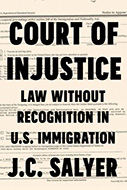
Last month, Kevin tipped y’all off to this new book from J.C. Salyer: Court of Injustice: Law Without Recognition in U.S. Immigration (Stanford University Press, 2020).
Today, let me point you to the recently published review of that same book by Anita Maddali (NIU). Anita writes:
[A] seasoned immigration attorney himself, and an anthropologist, Salyer frames his book, Court of Injustice: Law Without Recognition in U.S. Immigration, around the Supreme Court’s decision in Trump v. Hawaii, by highlighting the plenary power doctrine, which gives Congress and the President nearly unfettered discretion in the realm of immigration. While many hoped that the Supreme Court would find President Trump’s travel ban unconstitutional, Salyer explains that the “state of exception” within which immigration law operates and is justified “by portraying immigrants as racialized others threatening to society,” is one that immigration attorneys, but not necessarily the public, know all too well (p. 4)….
Salyer begins with a chapter entitled Migrants, Criminal Aliens and Folk Devils, in which he outlines the historical parallels between the harsh treatment of children within the juvenile and criminal justice systems with the increasingly punitive treatment of immigrants. In moments of “moral panic,” he explains, groups of people are identified as irredeemable, and extreme laws are enacted to quell social and cultural anxieties around perceived declines in the moral functioning of society (p. 36-38). In the context of immigration, lawmakers have constructed a binary relationship between aliens and citizens, with aliens representing dangerous others who pose a threat to society. Salyer demonstrates how, historically, the loss of discretion in criminal law mirrors the loss of discretion within immigration law, where immigration judges are, in many cases, unable to consider personal and social factors to offer relief from deportation….
Salyer’s significant contribution begins when he merges his legal expertise with his anthropological ethnography work. Through his fieldwork, he explores the role of immigration lawyers and judges in New York City. He comes to understand their role from interviews with lawyers, and from an anonymous survey of immigration judges who shared their perspectives. From these interviews and the survey results, we learn of the frustrations that both judges and lawyers face within a system that is rigid and unforgiving, placing people into legal categories, rather than allowing judges to consider the equities of individual cases. At the same time, we are offered a glimpse into the motivations of attorneys who continue to persist within such an unforgiving system. They regularly use their legal acumen, creativity and grit to advocate on behalf of their clients, and in doing so, have found some immigration judges who would assist them in this work….
This book impressively combines legal and anthropological expertise, contrasting the nuance of law and practice with the on-the-ground experiences of individuals working within the system. There is much to deconstruct in the realm of immigration law, but by interrogating the every day experiences of lawyers, we are able to catch a glimpse of effective forms of resistance, such as the program in New York City, absent legislative reform. By understanding the intricacies of the practice of immigration law, Salyer offers his readers insight into both the challenges and complexities of practicing within this system, and the possibilities for liberatory change.
-KitJ