
Immigrant of the Day: I. M. Pei
I. M. Pei (Ieoh Ming Pei) (Chinese: 貝聿銘; Pinyin: Bèi Lùmíng; b. April 26, 1917), commonly known by his initials I. M. Pei, is a Pritzker Prize-winning Chinese American architect, known as the last master of high modernist architecture. He works with the abstract form, using stone, concrete, glass, and steel. Pei is one of the most successful architects of the 20th century.
Pei was born in Canton (now called Guangzhou), in China on April 26, 1917. His first education was at St. Paul’s College, Hong Kong and then at Saint John’s University, Shanghai before moving to the United States to study architecture at the age of 18. He started at the University of Pennsylvania before going on to receive his Bachelor of Architecture degree from Massachusetts Institute of Technology in 1940. That same year, he was awarded the Alpha Rho Chi Medal, the MIT Traveling Fellowship, and the AIA Gold Medal. He enrolled at the Harvard Graduate School of Design two years later; shortly thereafter, he served at the National Defense Research Committee in Princeton, New Jersey. In 1944 he returned to Harvard, received his master degree in Architecture in 1946 and stayed at Harvard as an assistant professor. He received the Wheelwright Traveling Fellowship in 1951 and became a naturalized citizen of the United States in 1954.
In 1948, William Zeckendorf hired Pei to work at the real estate development corporation Webb and Knapp in a newly created post — Director of Architecture. While at Webb and Knapp, Pei worked on many large-scale architectural and planning projects across the country. Pei founded his own architectural firm in 1955, which was known as I. M. Pei & Partners until 1989 when it became known as Pei Cobb Freed & Partners recognizing James Ingo Freed and Henry N. Cobb. Pei’s projects include:
1954–1959 — Mile High Center, in Denver, Colorado, USA
1961–1967 — National Center for Atmospheric Research, in Boulder, Colorado, USA
1966 — Silver Towers at New York University
1967 — Hoffman Hall at University of Southern California
1968–1972 — 50 FAA air traffic control towers, in various locations throughout the United States. 1968–1974 — Christian Science Center, in Boston, Massachusetts
1971 — Harbor Towers, in Boston, Massachusetts
1972 — Dallas, Texas City Hall
1972 — Paul Mellon Arts Center at Choate Rosemary Hall in Wallingford, Connecticut
1972 — Pei Residence Halls at New College of Florida, Sarasota, Florida
1973 — Spelman Halls at Princeton University
1973 — Herbert F. Johnson Museum of Art, Cornell University, in Ithaca, New York
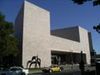
1974–1978 — East Building, National Gallery of Art, in Washington, DC
1976 — John Hancock Tower, in Boston, Massachusetts — Pei gives Henry Cobb the credit for this building 1976
1978–1982 — Indiana University Art Museum in Bloomington, Indiana
1979 — John F. Kennedy Library, in Boston, Massachusetts
1979 — One Dallas Centre, in Dallas, Texas
1979 — Baltimore World Trade Center, in Baltimore, Maryland
1979–1986 — Javits Convention Center in New York, New York
1981 — the Texas Commerce Tower in Houston, Texas, currently the JPMorgan Chase Tower; (3D/International cooperated with Pei on the design of this building)
1982 — Apartment for Steve Jobs
1983 — ARCO Towers
1989 — Carl Icahn Center for Science at Choate Rosemary Hall in Wallingford, Connecticut
1989 — Headquarters for Creative Artists Agency, Los Angeles, California
1989 — Pyramids of the Louvre, in Paris, France with Peter Rice Pyramide du Louvre website.
1991 — Miho Museum, Shiga, Japan
1992 — The Kirklin Clinic of the University of Alabama at Birmingham Health System, Birmingham, Alabama
1994 — Four Seasons Hotel New York, New York City, New York
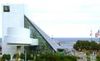
1995 — Rock and Roll Hall of Fame, in Cleveland, Ohio
2006 — Martha Stewart Center for Living at Mount Sinai Hospital in Manhattan (currently under construction).
2004–2007 — Museum of Islamic Arts in Doha, Qatar
2002–2008 — Ronald Reagan UCLA Medical Center in Los Angeles, CA
2009 — NASCAR Hall of Fame, Charlotte, North Carolina.
 KJ
KJ