
Immigrant of the Day: Hannah Arendt
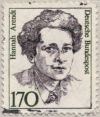 Hannah Arendt (1906–1975) described herself not as a philosopher but as a political theorist because her work centered on the fact that “men, not Man, live on the earth and inhabit the world.”
Arendt was born in Germany. At the University of Marburg, she studied philosophy with Martin Heidegger, with whom she embarked on a stormy romantic relationship. In the wake of one of their breakups, Arendt moved to Heidelberg and wrote her dissertation on the concept of love. The dissertation was published the same year, but Arendt was prevented from habilitating, a prerequisite for teaching in German universities, because she was Jewish. She worked for some time researching anti-Semitism before being interrogated by the Gestapo, and thereupon fled Germany for Paris.
While in France, Arendt worked to support and aid Jewish refugees. She was imprisoned in Camp Gurs for a couple of weeks. With the German military occupation of parts of France during World War II, and the deportation of Jews to Nazi concentration camps, Arendt was forced to flee France. In 1941, Arendt escaped to the United States with the assistance of an American diplomat, who illegally issued visas to her and around 2500 other Jewish refugees.
Arendt became active in the German-Jewish community in New York. She worked as the Executive Secretary for Jewish Cultural Reconstruction, Inc. In 1950, Arendt became a naturalized U.S. citizen.
Arendt was a visiting scholar at the University of California, Berkeley, Princeton, Columbia, and Northwestern. She also served as a professor on the Committee on Social Thought at the University of Chicago, as well as at The New School in New York City, and served as a fellow at Yale and Wesleyan. In 1959, she became the first woman appointed to a full professorship at Princeton.
Arendt’s work deals with the nature of power, and the subjects of politics, authority, and totalitarianism. Much of her work focuses on affirming a conception of freedom. Arendt’s work includes:
The Origins of Totalitarianism (1951)
The Human Condition (1958)
Between Past and Future (1961)
On Revolution (1962)
Eichmann in Jerusalem: A Report on the Banality of Evil (1963)
Men in Dark Times (1968)
Crises of the Republic: Lying in Politics; Civil Disobedience; On Violence; Thoughts on Politics and Revolution (1969)
The Jew as Pariah: Jewish Identity and Politics in the Modern Age (Edited by Ron H. Feldman, 1978)
Life of the Mind (1978)
Responsibility and Judgment. Edited and with an introduction by Jerome Kohn. Schocken Books. 2003.
Essays in Understanding, 1930-1954: Formation, Exile, and Totalitarianism. Edited by Jerome Kohn. Schocken Books. 2005.
On Violence. Harvest Books. 1970.
KJ