
Immigrant of the Day: Anthony Joseph Celebrezze Sr. (Italy)
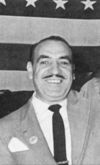 Anthony Joseph Celebrezze Sr. (1910–1998) was a Democratic politician, who served as mayor of Cleveland, Ohio, a cabinet member in the Kennedy and Johnson administrations, and as a U.S. court of appeals judge.
Celebrezze was born in Anzi, Italy, but moved with his family to the United States as a young child. He served in the U.S. Navy during World War II. He attended Ohio Northern University, where he received a J.D.
In 1950, Celebrezze ran for a seat on the Ohio State Senate and won. He served as an Ohio state senator from 1951 to 1953. Celebrezze resigned to successfully run for Mayor of Cleveland. Celebrezze was mayor of Cleveland, Ohio, from 1953 to 1962. In 1958, he unsuccessfully sought the Democratic nomination for Governor of Ohio.
From 1962 to 1965, Celebrezze served in the cabinets of presidents John Kennedy and Lyndon Johnson, as the U.S. Secretary for Health, Education, and Welfare. One of Celebrezze’s most important achievements as secretary of HEW was separating the public assistance and child health and welfare functions from the Social Security Administration and transferring these programs to a new Welfare Administration. Under Celebrezze’s watch, HEW was granted power to deny funds for any federal program, to any state, or institutions which practiced racial segregation.
In 1965, President Johnson appointed Celebrezze to the U.S. Court of Appeals for the Sixth Circuit. He served as a federal appeals court judge until his death in 1998.
During his years on the Sixth Circuit, Judge Celebrezze authored a number of distinguished opinions. In Beasley v. United States, he established the standard of “effective assistance of counsel” under the Sixth Amendment. In Hill v. Tennessee Valley Authority, Judge Celebrezze held that the district court had erred in its refusal to issue an injunction against building a dam over a river in which an endangered species, the snail darter, was found. The opinion stated that Endangered Species Act violations must be enjoined despite strong equitable arguments to the contrary in special instances, such as in the Hill case. The Tennessee Valley Authority was directed to seek any exemption from the restrictions within the Act by an appeal to the Congress, if TVA so desired. In Gabriele v. Chrysler Corp., Judge Celebrezze held that an aggrieved person need not resort to state agencies prior to commencing an Age Discrimination in Employment Act lawsuit in federal court.
In dissent, too, Judge Celebrezze made law. In Krause v. Rhodes, the Sixth Circuit held that executive immunity is absolute, thereby barring suit by injured Kent State students against various state officials. In dissenting, Judge Celebrezze held executive immunity to be relative, dependent on the actor’s state of mind. The Supreme Court reversed the Sixth Circuit, adopting the dissent’s reasoning. And in the area of criminal law, the Sixth Circuit held that mere possession of a firearm by a previously convicted felon is a federal offense, in violation of 18 U.S.C. §1202(a)(1). Judge Celebrezze, in dissent, argued that the government must also prove that the firearm in question was “in commerce or affecting commerce.” The Supreme Court, in United States v. Bass, adopted Judge Celebrezze’s view.
During his years of serving the public, Judge Celebrezze garnered many honors and awards. Among them were honorary degrees from Fenn College, Boston College, LaSalle College, Ohio Northern University, Rhode Island College, Bowling Green State University, Wilberforce University, Miami University (Ohio) and Cleveland State University.
The U.S. government building in Cleveland is named after Celebrezze.
KJ