
Will Boycott of Arizona Yield Results?
From Julianne Hing of Colorlines:
It has been four weeks since Arizona Gov. Jan Brewer signed the state’s controversial SB 1070, and efforts to boycott the state have been mounting ever since. Calls for a boycott actually began days before SB 1070 even became law, when Arizona Rep. Raul Grijalva warned the business community to prepare for backlash. 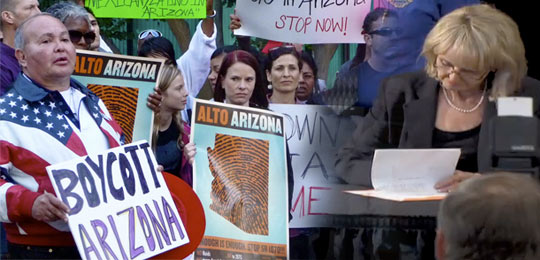
“We’re asking organizations, civic, religious, labor, Latino, organizations of color to refrain from using Arizona as a convention site, to refrain from spending their dollars in the state of Arizona,” he said on Keith Olbermann’s MSNBC show that week, “until Arizona turns the clock forward instead of backwards and joins the rest of the union.”
SB 1070 requires that people show proof of their immigration status if they’re questioned by police, and empowers police to ask for such proof when they’re enforcing local and state laws, and even civil code. Civil rights groups have called SB 1070 unconstitutional; five separate lawsuits are now challenging it.
But while lawyers head to court, immigrant rights organizers are funneling the national outrage into a widespread, multi-pronged boycott against Arizona. Calls to move next year’s baseball All-Star Game out of Phoenix have drawn the most attention. But the boycott effort is gaining ground among convention planners and in local governments, too, particularly in cities with significant immigrant communities.
On Tuesday, Seattle passed the latest city resolution declaring a boycott of Arizona–and became the eleventh locality in the United States to do so. Seattle joined the ranks of cities like Austin, Texas; Boston; Los Angeles; Oakland; St. Paul, Minn. and Washington, D.C., who’ve all vowed some form of economic response, ranging from clear travel bans for employees to more vague contracting commitments. (See graphic at end of article for details.)
City officials in Dallas are mulling their own resolution, as are New Yorkers. Cook County, which encompasses Chicago, is considering its own boycott. Cities are folding their arms, turning up their noses and giving nasty looks at the Grand Canyon State. They don’t want to be part of a club that proudly relies on racial profiling to crack down on immigrants.
But all of this begs an important question about boycotting as a tool for reform: Does it work? And if so, under what conditions?
“Boycotts are tricky business,” warns Dana Frank, a professor of history at the University of California, Santa Cruz.
Precedent shows that if they’re carried out in a strategic way, boycotts can be effective—the famous thirteen-month Montgomery, Ala., bus boycott in 1955 is a favorite example among historians of a smartly executed campaign. But efforts that do not have clearly outlined objectives and pathways of transmitting pressure often collapse. “Boycotts historically are most effective when they have a very specific target, or when they are part of a multi-pronged approach,” says Frank.
Boycotts are also notoriously easy to start and hard to finish. Lawrence Glickman, a professor of history at the University of South Carolina and the author of Buying Power: A History of Consumer Activism in America, cites the NAACP’s 1990s boycott of South Carolina as an example of what can happen when targets and objectives aren’t clearly outlined. The NAACP announced a boycott of South Carolina in 1992 because the state refused to stop flying the Confederate flag at the capitol building. But when the state moved the flag from the top of the dome to the capitol grounds in 1999, there was confusion about whether they’d found an acceptable compromise.
As recently as March of this year, people have debated whether the South Carolina boycott’s still going on, and disagreements have led to public tussling between the NAACP and other Black community leaders. “There was a lot of ambiguity, and that led to a loss of momentum,” says Glickman.
bh