
Blogging from Vietnam — Part 4
I spoke earlier with two partners at two different, prominent, international law firms in Ho Chi Minh City. One is from Singapore and has worked here for twelve years. The other is from Ohio and has been here for three. The first has seen an amazing transformation of Vietnam over the past decade as it came to work more with the U.S. as Vietnam worked toward entering the WTO. The second has seen great change even in three years, as the attitude of businesses and government officials evolves ever so quickly.
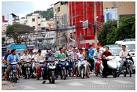
As I walk around (being very careful crossing the street!!), I also encounter many Viet Kieu or overseas Vietnamese from the U.S. who were refugees and who are here as tourists or visiting relatives. My conversations with them raise complex reactions from them, but they are happy to be visiting.
Southeast Asian refugees to the U.S. posed a distinctive resettlement challenge when they first start arriving in 1975. They became the largest refugee group ever to so rapidly enter the country, and the challenge they presented came early when they came in entirely unanticipated numbers.
On April 18, 1975, President Gerald Ford created a temporary Interagency Task Force (IATF) to coordinate the activities of twelve federal agencies. The temporary character of the IATF proved problematic. As if to convince itself that a temporary task force could manage the assignment, IATF perceived and treated the refugee problem as though it were temporary. As a result, its policies did not carefully consider the long-term effects on the refugee community. IATF’s rush to supervise led to sloppy sponsorship arrangements, some of which broke down almost immediately, leaving many refugees alone and unaided. Others served employers looking for cheap labor or subservient workers and exploited refugees.
More to the point, the short-sightedness of IATF led to the misguided decision to disperse Vietnamese refugees as widely as possible, rather than to concentrate them in assigned areas. For those who wished to maintain control over the Vietnamese, assigning them to a few central locations seemingly promised to keep them where they could be more easily monitored and manipulated. At the same time, however, it increased opportunities for refugees to communicate with and reinforce each other, perhaps enabling them to form alliances and mobilize.
bh