
Theorizing Immigration Control by Colin Grey
Theorizing Immigration Control
The injustices that result from immigration governance are glaring. They are so glaring that normative theorizing about such governance may seem, at best, a low priority. At worst, theorizing may seem a way of legitimizing the illegitimate.
Taken too far, this anti-theoretical attitude would be a mistake. There remains a pressing need to resolve political-moral questions concerning immigration governance.
In particular, the standard view that it is morally proper for states to have broad, possibly unfettered, power to control immigration is a root cause of many of the injustices associated with immigration. This view can only be met by attempts, theoretical in nature, to come to grips with the nature and limits of the power to control immigration.
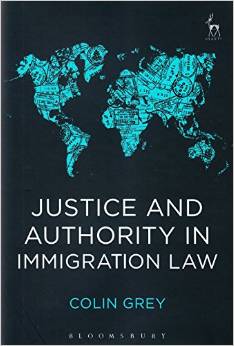
While it suffers from inadequacies, I believe my book – Justice and Authority in Immigration Governance (2015) – makes progress toward a better understanding of what reasonably just immigration governance would look like. Below, I briefly describe the book’s claims in the presumptuous hope of provoking others to engage with the arguments for these claims.
To begin, I do not deny the right to control immigration; although I believe this right resides with states for essentially contingent reasons. Further, this right is not one of “absolute and unqualified” control. Rather, it is a right to exercise judgment regarding whether an immigrant should be admitted or not to a state’s territory.
To command authority, this judgment must be exercised reasonably. It must take account of both would-be migrants’ circumstances as well as the impact immigration will have on a receiving state. If this power of judgment is not exercised reasonably, migrants will have no obligation to obey immigration law, with all the instability this result implies.
Most rich, liberal states pursue unreasonable immigration policies now. Such unreasonableness is made manifest in the overall inegalitarianism of these policies. The tendency of most rich states to admit the well off and exclude (or exercise greater control over) the worse off leads to a disturbing correlation between disadvantage and the likelihood of suffering. Inegalitarian admissions policies are likely also unreasonable in themselves, evincing profound disregard for the situation of worse off migrants and the impact immigration would have on their lives.
What would it be to exercise the power of judgment over immigration reasonably? I propose four principles in my book.
First, any cap on immigration must be set in accordance with considerations of the need to maintain stability and the need to respect members’ legitimate expectations.
Second, under any such cap, priority of admission must be given to the worst off, where being “worst off” is a function of both the absence of rights and economic disadvantage.
Third, immigration policies must avoid second-order injustice; that is, any policy regarding admission or exclusion must not result in or require for their enforcement such blatant injustices as indefinite detention or the use of excessive force.
Fourth, there are certain migrants that states are obligated to admit to citizenship. Those are the migrants who develop a form of allegiance, which I call “juridical integration”, to the rules and principles of justice embodied and guaranteed by a state.
If you have read this far, this summary will have raised more questions than it answers. It has likely provoked skepticism. Good. I believe the principles above will minimize injustice in immigration governance and allow for the reconciliation of both migrants and non-migrants with the social and political world that results. But I also think the arguments in my book are insufficient. Making them more robust is the long-game in addressing the great evils that result from immigration control by states.
Colin Grey (grey.colin@uqam.ca) is professeur régulier en droit des migrations at the Université du Québec à Montréal (UQÀM) and a former legal advisor to the Immigration and Refugee Board of Canda. His book, Justice and Authority in Immigration Law was published by Hart Publishing earlier this year.