
Immigration Highlights from the AALS Clinical Conference
Earlier this week, clinical law professors from around the country gathered for the annual American Association of Law Schools (AALS) Clinical conference. This year’s conference theme was, “Clinics and Communities: Exploring Community Engagement Through Clinical Education” and was held along the Baltimore, Maryland waterfront.
As with every AALS clinical conference, the program offered a rich set of sessions focused on immigration-related topics, with strong participation from those of us who teach in immigration/immigrants’ rights clinics. This year, the Clinical Law Review held a concurrent symposium on the first two days of the conference to celebrate the 25th anniversary of Gerald Lopez‘s seminal work, Rebellious Lawyering. The symposium, entitled “Rebellious Lawyering at 25,” included a breakout session on Immigrants’ Rights that featured the work of Ramzi Kassem (CUNY) and Diala Shamas (Stanford) discussing their work around national security and immigration-related advocacy on behalf of Middle Eastern immigrant communities in New York City as well as Brenda Montes, (Franco Law Group) discussing the application of rebellious lawyering principles to her private immigration law practice in Los Angeles. I had the pleasure of moderating the immigrants’ rights session. The print version of the symposium will also include articles by Bill Ong Hing (USF) and Karla McKanders (Tennessee). A number of other symposium panelists, including Betty Hung (Asian Americans Advancing Justice), Martha Gomez (MALDEF) and Alfredo Mirande (UC Riverside – Sociology) highlighted immigration-related themes. Sameer Ashar (UC Irvine) served on the planning committee for the symposium.
Concurrent sessions during the conference raised the challenges, opportunities and practical implications of teaching in law school clinics that engage with communities, conduct broader advocacy, and respond to crisis. One concurrent session, entitled “Reimagining Advocacy: Adapting Clinical Models to Meet Community Needs,” focused on various responses to the human rights crisis related to Central American migration and the return of family detention, and was presented by Farrin Annello (Seton Hall), Kate Evans (Minnesota, but soon to join Idaho Law), Denise Gilman (Texas), Jennifer Lee (Temple), Ranjana Natarajan (Texas), Sarah Paoletti (UPenn), Elissa Steglich (Texas), Philip Torrey (Harvard), Michael Vastine (St. Thomas), and Sheila Velez-Martinez (Pittsburgh). (Most of whom are pictured below)
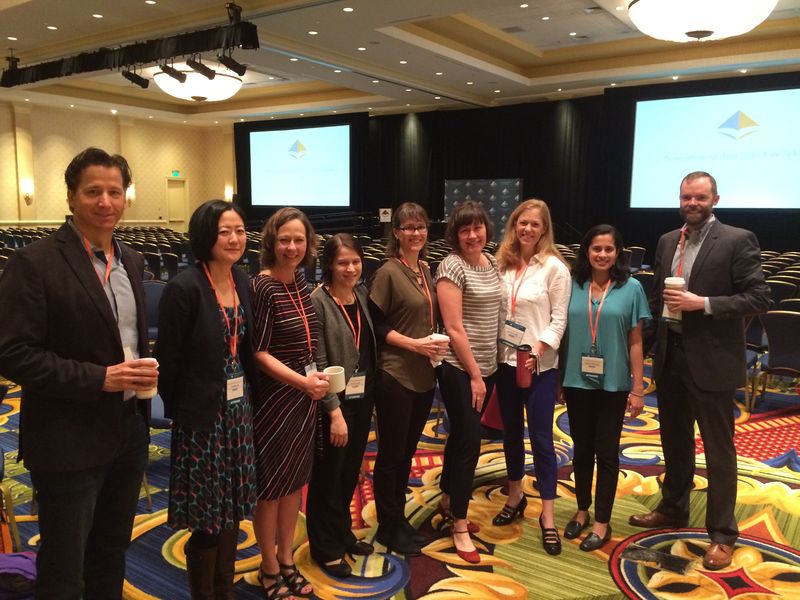
Another session focused clinics that prioritize individual representation and run for one semester, and the challenges associated with including community advocacy projects into those clinics, and was facilitated by Elizabeth Keyes (Baltimore), Sarah Rogerson (Albany) and me (Western State). Immprofers appeared throughout the rest of the program, including (but not necessarily limited to) Christopher Lasch (Denver), Katie Tinto (Cardozo), Beth Lyon (Cornell), Julia Vasquez (Southwestern), Annie Lai (UC Irvine), Michael Kagan (ULNV).
The conference also included a number of works-in-progress presentations from Immprofers. Sarah Sherman-Stokes (Boston Univ.) presented on mental competency findings by Immigration Judges, with commentary from Ragini Shah (Suffolk). Emily Torstveit Ngara (Baltimore) presented on the use of solitary confinement in immigration detention, with Christine Bustany (Suffolk) serving as discussant. Jenny Brooke-Condon (Seton Hall) presented on immigration federalism, with commentary from Denise Gilman. Suzan Pritchet (Wyoming) spoke on protecting undocumented crime victims, with commentary from Maureen Sweeney (Maryland). Geoffrey Heeren (Valparaiso) presented his paper on immigrants and the right to work, which Jason Parkin (Pace) commented on. Medha Makhlouf (Penn State) spoke on immigration law’s treatment of married children, with feedback from Elizabeth Keyes. And, Becky Sharpless (Miami) presented on “Cosmopolitan Democracy and the Detention of Immigrant Families,” with discussion led by Sarah Rogerson.
Finally, immigration clinicians met periodically throughout the conference for working group discussions, led by Maureen Sweeney and Emily Torstveit Ngara. As always, those groups provided for the exchange of ideas, strategies, challenges and the joys of clinical teaching.
(Check out the Twitter hashtag #AALSClinical for more on the conference).
-JKoh