
The face of immigration with Trump as president

“When Mexico sends its people, they’re not sending their best. They’re not sending you. They’re not sending you. They’re sending people that have lots of problems, and they’re bringing those problems with us. They’re bringing drugs. They’re bringing crime. They’re rapists. And some, I assume, are good people.” –Donald Trump
Guest blogger: Nicholas Gonzales, first-year law student, University of San Francisco:
Presidential Candidate Donald Trump’s campaign stance on U.S. immigration, most explicitly on the Mexico border, is very clear. On his official campaign site TRUMP: MAKE AMERICA GREAT AGAIN!, Trump emphasizes that “we are the only country in the world whose immigration system puts the needs of other nations ahead of our own. That must change.” His proposal for “real immigration reform” revolves around three core principles:
1. A nation without borders is not a nation. There must be a wall across the southern border.
2. A nation without laws is not a nation. Laws passed in accordance with our Constitutional system of government must be enforced.
3. A nation that does not serve its own citizens is not a nation. Any immigration plan must improve jobs, wages and security for all Americans.
Additional objectives of Trump’s immigration reform policy include tripling the number of ICE officers; defunding uncooperative local governments; and requiring companies to “hire American workers first.” It’s no surprise that Trump’s reactive approach to immigration reform, and many of his political views, have sparked inescapable controversy amongst the presidential candidates. It’s apparent that given the current state of U.S. immigrations, we need a candidate to propose viable solutions to the problem. Donald Trump is not that candidate.
“A nation without borders is not a nation.” The U.S. was founded by immigrants and has thrived from the admission and prosperity of immigrants from outside its borders. Most of the greatest influences since the birth of this nation have been by first or second generation immigrants. Building a wall and further restricting immigrants from entering this nation would not only be a serious infringement on human rights, but more importantly for the success of the nation, a hindrance on future growth through diversification. It may be true that moderation of the flood gate that has become the U.S. border is needed, but any hydraulic engineer could tell you that further constraint on that stream only leads to increased pressure.
“Any immigration plan must improve jobs, wages and security for all Americans.” In its Hispanic Trends Project, the nonpartisan Pew Research Center has found that the U.S. currently employs approximately 8.4 million undocumented immigrants, representing nearly 5.2 percent of the nation’s work force. This figure has increased by 1.4 percent since 2000. Texas Comptroller, Susan Combs, proclaims that, “without the undocumented population, Texas’ work force would decrease by 6.3 percent,” which would result in a 2.1 percent decrease in Texas’ gross state revenue. Texas is the fourth highest accruing state economy in the U.S. The U.S. Department of Labor further reports that of the 2.5 million farm workers in the U.S., over half (53 percent) are undocumented immigrants.
Furthermore, the U.S. Department of Agriculture found that, “about half of the hired workers employed in U.S. crop agriculture were unauthorized, with the overwhelming majority of these workers coming from Mexico. Any potential immigration reform could have significant impacts on the U.S. fruit and vegetable industry.”
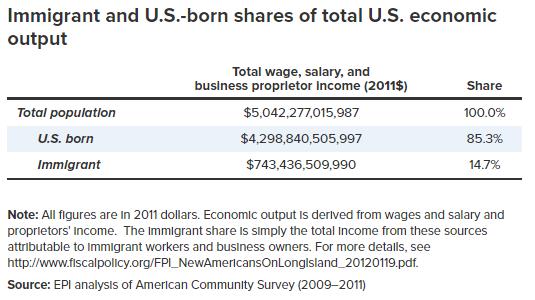
Plain and simple, Trump’s solution to improving the U.S. economy and domestic job stimulation is by restricting almost 15% of the nation’s workforce and literally defunding local governments that don’t align with his radical policies. But maybe requiring companies to “hire American workers first” could solve that problem. If only Trump could figure out a way to make American workers want to do the jobs most immigrants have no other choice to take, on the fields and in the factories.
Friederich Drumpf migrated to the United States in 1885 with nothing to his name, founded a career in real estate, and before his death, managed to create a small fortune and substantial financial foundation for his children and future generations to come. When you think of the “American Dream,” stories like Frieferich’s seem to come to mind. When Donald Trump, Friederich’s grandson, announced his presidential candidacy, the notion of the American dream became less conceivable. Trump as president would mean the U.S. would no longer be a country whose immigration system puts the needs of other nations ahead of our own, preventing stories like Friederich’s from being possible.
bh