
Teaching Family-Based Migration In The Context of “Chain Migration” Rhetoric
It has never been more exciting to teach family-based migration. No longer do students’ eyes glaze over as they struggle to read the visa bulletin. No, they are riveted. And we have President Trump to thank.
President Trump is avidly against family-based migration, which he calls “chain migration.”
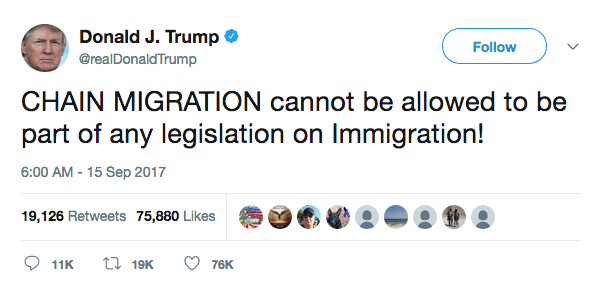
The president sees immigration based on family relationships as pushing out merit-based migrants, which he favors. Trump has also indicated that family-based migration might be problematic from a national security standpoint. Check out this press briefing following Sayfullo Saipov’s October 2017 attack in NYC. Watch particularly from 1:48-2:20. (Hat tip to my student Kat Sand who pointed me to this press briefing; I hadn’t picked up on the chain migration implications at the time.)
There’s so much to unpack in those 30 seconds of tape! For those who don’t recall, Saipov came to the U.S. on a diversity visa. He was unmarried and childless, meaning he had no spouse or children “accompanying or following to join” pursuant to INA 203(d). At the time of the attack, Saipov was an LPR, not a U.S. citizen. Therefore, Saipov was ineligible to sponsor the migration of any family members apart from his spouse and unmarried sons and daughters. INA 203(a)(2). But Saipov married and had kids in the U.S. so he didn’t in fact sponsor any family members. Yet in the above speech, Trump states that Saipov was the “primary point of contact” for “23 people that came in or potentially came in with him.” And it’s this sort of “chain migration” that Trump calls “not acceptable.” (For the record, both the NYT and WaPo called Trump out for his inaccurate statements regarding Saipov’s family-based sponsorships.)
You can couple the above clip with Problems 3 & 4 in the Legomsky/Rodriguez casebook (pages 276-277 in the 6th ed.). They’re great problems that force students to read and use the visa bulletin, understanding just how long it takes to bring in family members from overseas. Also, done back-to-back, they illustrate the issues of aging out discussed in the Scialabba v. Cuellar de Osorio case.
For fleshing out policy discussions on chain migration, consider pairing this White House blog on chain migration with this Vox piece on the same topic, which we highlighted previously. There’s also this story about one of the most successful U.S. chain migrants.
In addition to all these goodies, check out my post from last year about teaching family-based migration. Happy teaching!
-KitJ
P.S. Immprof Alan Hyde points out that #resistancegeneology (covered in this article) is another genius way to talk about chain migration.