
From the Bookshelves: Court of Injustice: Law Without Recognition in U.S. Immigration by J.C. Salyer
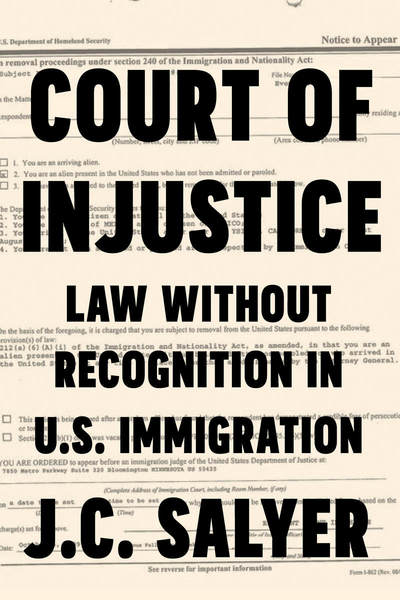
This book is an account of the effects of the implementation of U.S. immigration law and policy. Salyer engages directly with the specific laws and procedures that mandate harsh and inhumane outcomes for migrants and their families. Combining anthropological and legal analysis, Salyer demonstrates the economic, historical, political, and social elements that go into constructing inequity under law for millions of non-citizens who live and work in the United States. Drawing on both ethnographic research conducted in New York City and on the author’s knowledge and experience as a practicing immigration lawyer at a non-profit organization, this book provides unique insight into the workings and effects of U.S. immigration law. Court of Injustice provides an up-close view of the experiences of immigration lawyers at non-profit organizations, in law school clinics, and in private practice to reveal limitations and possibilities available to non-citizens under U.S. immigration law. In this way, this book provides a new perspective on the study of migration by focusing specifically on the laws, courts, and people involved in U.S. immigration law.”
Austin Kocher reviews the book here. He writes “Court of Injustice is entirely accessible without losing an ounce of rigor or rich detail, which is remarkable in light of the fact that immigration law is notoriously complicated. Salyer illustrates how and why the particulars of immigration law matter in a broad social and political context and how they likely arise. “
KJ