
From the Bookshelves: Open Hand, Closed Fist: Practices of Undocumented Organizing in a Hostile State
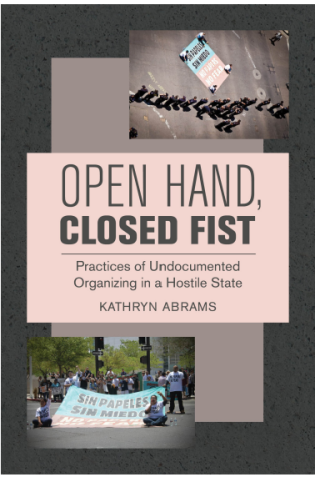
Kathryn Abrams, Herma Hill Kay Distinguished Professor at UC Berkeley Law School, has authored a new book titled “Open Hand, Closed Fist: Practices of Undocumented Organizing in a Hostile State” (UC Press 2022). The book is based on ethnographic research and interviews with activists from the undocumented immigrant social movement in Arizona in the years following SB 1070.
Having reading the manuscript, I can say the research is as compelling as it is in-depth. Professor Abrams’ background as a social movement scholar foremost lends an unique perspective on the goals of immigrant activists that is unbounded by taken-for-granted constraints of the existing legal system. For example, the notion of “performative citizenship” intrigues me as an immigration law professor who has focused on the intricacies of expanding access to formal citizenship; it also challenges me to learn that activists sometimes forgo formal citizenship to achieve meaningful practical gains and forge their own sense of belonging that is not dependant on a hostile state. For all of the rich storytelling about the trajectory of a particular movement in a particular place at a particular moment in time, the theoretical insights provide a broader understanding about movement community organizing without legal status.
From the publisher’s website:
How does a group that lacks legal status organize its members to become effective political activists? In the early 2000s, Arizona’s campaign of “attrition through enforcement” aimed to make life so miserable for undocumented immigrants that they would “self-deport.” Undocumented activists resisted hostile legislation, registered thousands of new Latino voters, and joined a national movement to advance justice for immigrants. Drawing on five years of observation and interviews with activists in Phoenix, Arizona, Kathryn Abrams explains how the practices of
storytelling, emotion cultures, and performative citizenship fueled this grassroots movement. Together these practices produced both the “open hand” (the affective bonds among participants) and the “closed fist” (the pragmatic strategies of resistance) that have allowed the movement to mobilize and sustain itself over time.
The book can be preordered online with a 30% discount using a source code from this flyer.
MHC