
Day Four in Guadalajara
Wednesday was day four of the Rhizome program in Guadalajara.
We started the day at El Refugio Casa del Migrante. The shelter sit near the peak of the steep hill that defines this neighborhood. Migrants arrive atop the trains that run nearby. They jump off before rolling into the official train station, near the bottom of the hill, then climb the steep hill to reach the shelter. They know where to go because there is a map of shelters across the country to aid migrants in finding safe places to stay along their journey.
Padre Alberto Ruíz Pérez (“Father Beto”) is in charge, and he proudly showed us around the facility and told us how it operates. The Casa del Migrante offers food to anyone in the community who needs it, but they only provide shelter and services to migrants. The shelter has an abundance of open spaces–a beautiful patio with view of the city, perfect for parties, and a large outdoor recreation area for kids to play. This is a conscious design choice by Padre Alberto, who studied architecture before joining the seminary. He doesn’t want the migrants he aids to feel as though they are in prison.
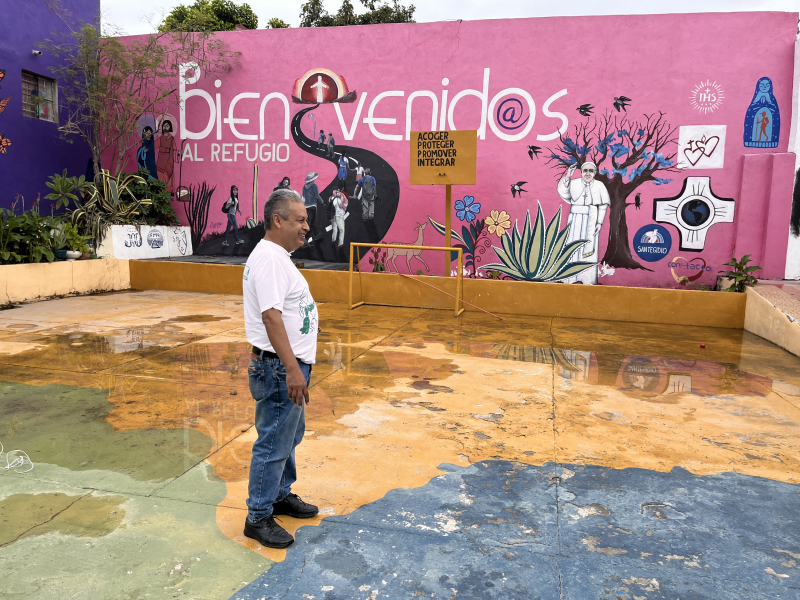
While many communities would balk at housing a migrant shelter, the El Refugio community is different. As poor as the neighborhood is, when a caravan of 2,0000 showed up, neighbors took in the overflow of migrants the shelter had to turn away. As Father Beto said, it was a case of the poor providing for the “even more needy.”
The work is not without its dangers. In 2017, Father Beto housed a Venezuelan reporter and his family within his own home. On a tip from the Mexican immigration authorities, the family moved from the priest’s home in the middle of the night. Two weeks later, armed guards burst into Father Beto’s home, looking for the reporter. Not finding him, they beat the priest to the point he could not speak. Now, he and his facilities have guards courtesy of the Human Rights Commission of Mexico.
Beyond the main migrant shelter, Father Beto has also established apartments for families. There are 8 currently in use. Another 8 are in the process of being built. They sit alongside a rabbit farm (with 400 rabbits!) to generate food.
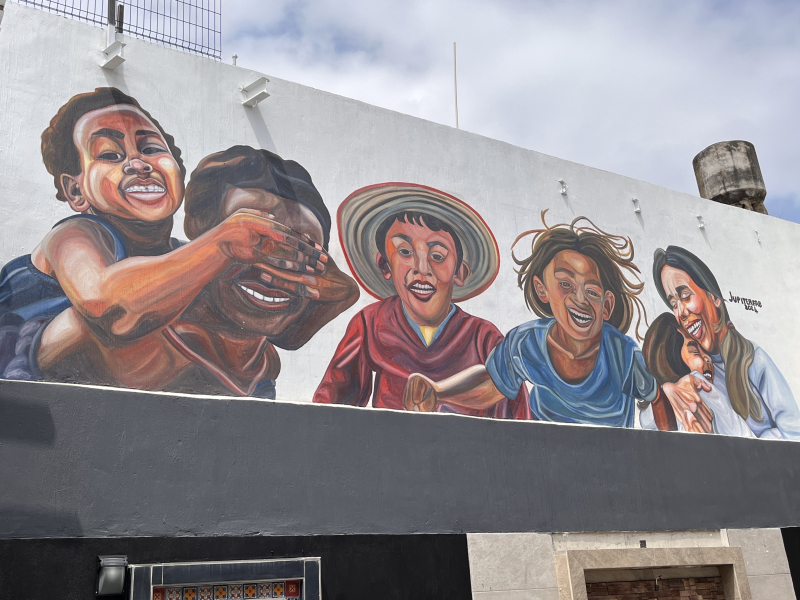
His latest project is a shelter for women and children that sits at the bottom of the neighborhood’s formidable hill. It opens on Monday. Like the main shelter, this smaller offshoot is thoughtfully designed, with attention paid to ample outdoor spaces and art. This beautiful mural sits above the courtyard recreational space.
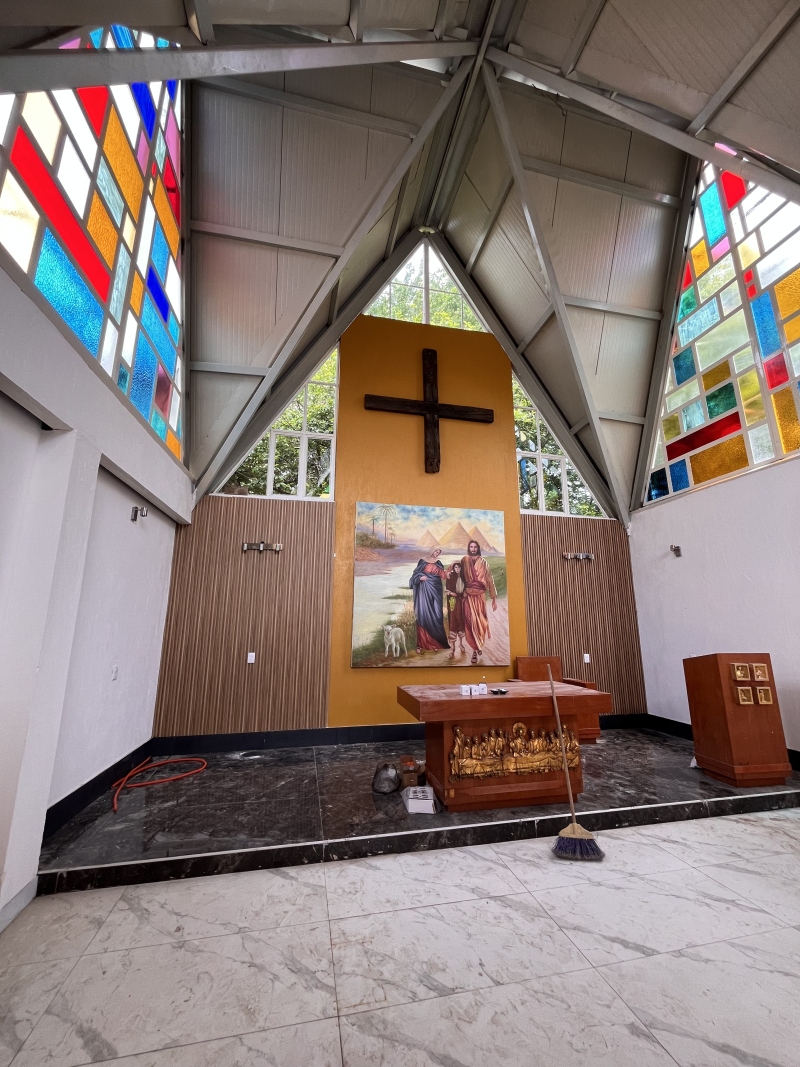
The facility’s chapel is stunning. The central cross is made of railroad ties. As Father Beto says, La Bestia is the cross that migrants have to bear. He intentionally left the windows behind the altar bare, to connect people to the nature outside (where another beautiful play space is located). The central image is one of the holy family–Mary, Joseph, and an older-than-usually-seen young Jesus. They walk with the migrants.
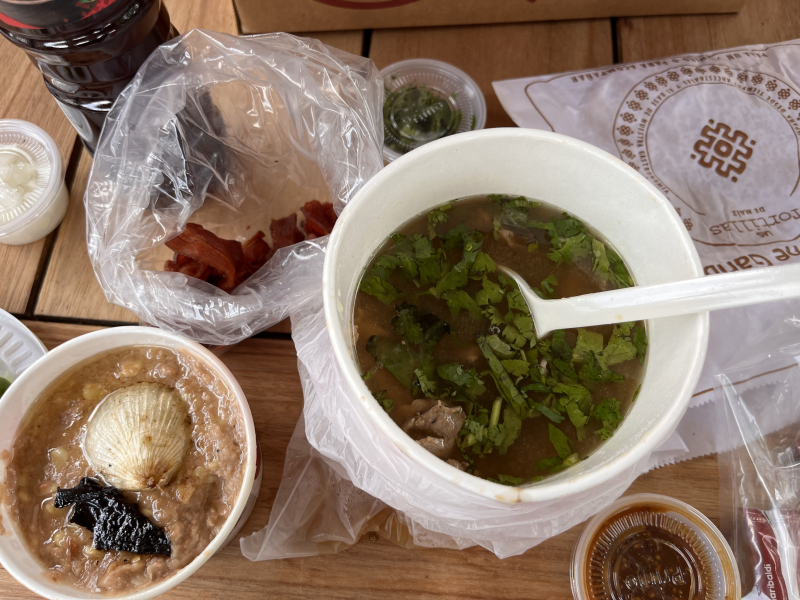
We returned to the hotel for a lunch of karne en su jugo. I could turn this blog into one long string of food images. Since I haven’t yet bored you with one, I’m including this because, let me tell you, it was scrumptious.
After lunch, we met with Adina Tejadilla of COMAR–the Comisión Mexicana de Ayuda a Refugioados (Mexican Commission for Refugee Assistance). Tran explains that COMAR “was established in 1980 by presidential decree and later formalized by the Mexican Law on Refugees, Complementary Protection and Political Asylum, to process refugee applications and offer protection and services to refugees and refugee petitioners.”
Ms. Tejadilla gave us a crash course on the Mexican asylum system. She told us that there are only three requirements to seeking asylum in this country: (1) be a foreigner, (2) be in Mexico, (3) ask for asylum. Migrants have just 30 days in which to pursue this form of relief. (And we thought a one-year deadline for asylum in the US was short!)

The grounds for asylum in Mexico are much broader than in the US. They cover gender, generalized violence, and internal conflict, among others.

And for those who cannot meet even those generous definitions, there is the option for “protección complementaria,” which sounds a bit like CAT relief. Like CAT, it is for people who can establish that they would be subject to torture if returned to their home country. Also like CAT, protección complementaria gives the migrant the right to stay in the country but not the right to bring their family to Mexico.

Other things I learned about Mexican asylum from Ms. Tejadilla include:
- There are 6 COMAR employees for the entire state of Jalisco. Only one adjudicates asylum applications.
- Asylum in Mexico is a “good faith process” that relies on the statements of asylum seekers. Evidence is great, but it’s not necessary.
- Criminal history and gang affiliation are grounds for denying asylum. COMAR relies on applicant disclosures about their own criminal/gang history. COMAR does no affirmative investigation to verify criminal history with the sending country. That said, COMAR relies on its own “training” to spot criminal and gang affiliation.
- Applicants must remain in the state where they apply for asylum until their case is fully adjudicated. They cannot relocate to a Mexican state that, for example, has more jobs.
- Denials are appealable.
- Political asylum is different from regular asylum. And it is adjudicated by a different agency–the Ministry of Foreign Affairs.
Our last meeting of the day was with Iliana Viramontes, a “protection associate” with the UNHCR. We met in her offices to learn about the work of UNHCR. She gave us a big picture view of the agency’s work country-wide as well as the specific work they do in Jalisco.
For example, one core mission of the UNHCR is “ensuring access to territory, information and the asylum procedure.” This is something that UNHCR offices on the Southern border of Mexico engage in on a regular basis. “Without interfering” in the work of COMAR at the border, UNHCR helps migrants entering the state of Mexico.
More recently, the UNHCR has been drawing attention to issues surrounding internal displacement in Mexico. Mexicans are increasingly being dislocated from the states of Michoacán, Guerrero, and Sinaloa. They’re pushing into Chihuahua.
In terms of Jalisco, the focus is on refugee integration. Every new weeks, a new group of refugees arrives in the city. They’re housed in a hotel to begin a 3-day introduction to Guadalajara that aims to see each refugee housed and employed by the end of the session. If you’d think that impossible, 72 of the last 80 cases met that standard by the end of three days. UNCHR helps them every step of the way–from finding rentals on Facebook marketplace and providing financial assistance for deposits to building relationships with local employers willing to hire refugees. They continue to work with the refugees on their community integration over the following six months.
Other interesting things we learned:
- The UNHCR provides 50% (HALF!) of COMAR’s annual budget.
- Integration is a fairly new branch of UNHCR work. Their handbook only dates to 2009.
- UNHCR had worked with local nonprofits to set up a separate welcome for kids while their parents are engaged in the intense work of finding a job and housing. One leader created a list of the soccer players on the local team and their countries of origin, to show kids that there are already people here in Guadalajara from their home countries.
- UNHCR is the only entity providing resettlement support in Mexico. The federal government expends 0$ on resettlement.
- Refugees can naturalize after 2 years of residency in refugee status, if they speak Spanish. Non-Spanish speakers (e.g. Haitians) must wait 5 years. That said, refugees in generally get to avoid the dreaded history exam other naturalization applicants must go through.
-KitJ