
David Bacon: Farm Labor in Oxnard
Here is a post from David Bacon:
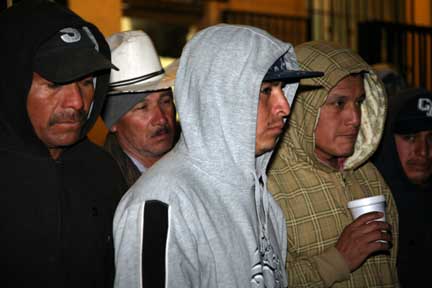




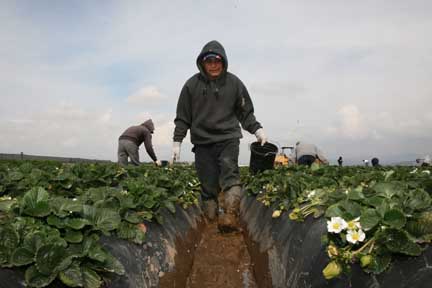


OXNARD, CA – 4FEBRUARY10 – At 5:00 in the morning, farm workers line the sidewalks on Cooper Road in La Colonia, the Mexican barrio of Oxnard, looking for work. Labor contractors or riteros (people who sell rides to the fields) stop and pick people up from this shape-up, for work picking strawberries, raspberries or other kinds of farm labor.
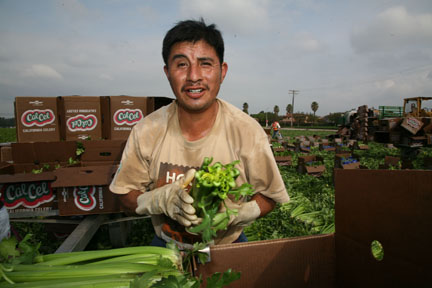
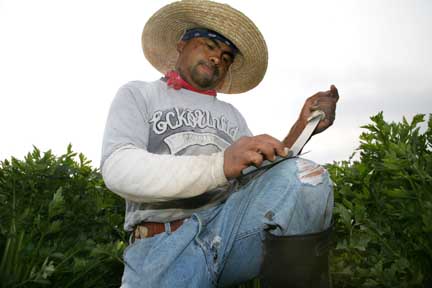
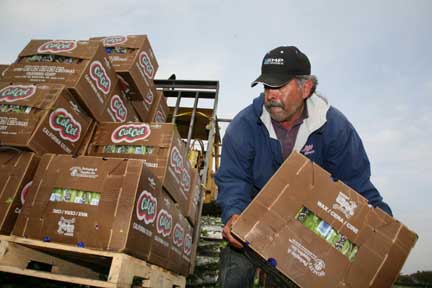
At the edge of town, a crew of farm workers cuts and packs celery for Hiji Brothers, a local rancher. As the crew moves through the field, cutters cut and trim the bunches. Cutters work quickly, often getting ahead of the rest of the crew. They stop and sharpen their knives, which they give a razor edge so that they can make three clean cuts in a blur — at the bottom, the top, and then trimming the sides of each bunch. Cutters are followed by packers, who pick up the bunches, bag them, and pack them into boxes on a metal carrier they push down the rows. Behind the packers, staplers close the boxes and loaders throw them onto shipping pallets, held by a big forklift. Celery is a better-paying job in farm labor, and workers usually work by piecerate.
In another field, the strawberry harvest has just started. There aren’t a lot of ripe berries yet, so workers are still paid by the hour. It’s been raining for weeks, so between the raised beds of strawberries, covered in plastic, the water has turned the rows into trenches filled with mud. Raspberries are grown under huge plastic sheets on a framework of plastic pipes, covering the whole field. The tents protect the plants from rain and direct sun. It’s very dusty, and the chemicals sprayed on the berries aren’t washed off by rain or wind. Women picking raspberries and other crops often wear bandannas to protect them from the dust. Workers are required to separate ripe berries from unripe and overripe ones, and one worker tastes a berry to decide. Foremen often require this practice, but it is no longer legal, since unwashed berries carry pesticides that can damage workers’ health.
In both the strawberries and raspberries, most workers are indigenous Mixtec, Zapotec and Purepecha people from Oaxaca and Michoacan. In the celery most farm workers are mestizo immigrants from other parts of Mexico.
For more articles and images, see http://dbacon.igc.org
For a Press TV interview about racism, globalization and illegality, see http://www.presstv.com/programs/detail.aspx?sectionid=3510529&id=112065#112065
See also Illegal People — How Globalization Creates Migration and Criminalizes Immigrants (Beacon Press, 2008) Recipient: C.L.R. James Award, best book of 2007-2008 http://www.beacon.org/productdetails.cfm?PC=2002
See also the photodocumentary on indigenous migration to the US Communities Without Borders (Cornell University/ILR Press, 2006) http://www.cornellpress.cornell.edu/cup_detail.taf?ti_id=4575
See also The Children of NAFTA, Labor Wars on the U.S./Mexico Border (University of California, 2004) http://www.ucpress.edu/books/pages/9989.htm
David Bacon, Photographs and Stories http://dbacon.igc.org