
The Meaning of the U.S. Government’s Defense of Immigrants and Minorities in Challenging the Immigration Laws in Alabama, Arizona, Etc.
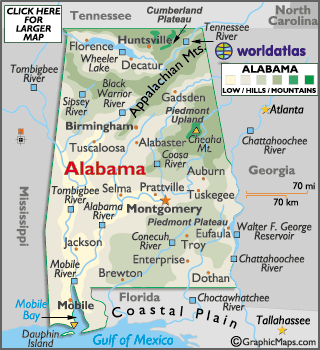
Courtesy of http://www.worldatlas.com/webimage/countrys/namerica/usstates/al.htm
Jerry Markon of the Washington Post writes about the U.S. government’s lawsuits against states, including Alabama and Arizona, challenging the constitutionality of their immigration laws. It was reported that the Justice Department was also considering challenging the immigration laws of Utah, South Carolina, and some other states. The article includes the following quote:
“`I don’t recall any time in history that the Justice Department has so aggressively challenged state laws,’” said Jonathan Turley, a constitutional law expert at George Washington University Law School.”
I had two responses to Professor Turley’s statement. First, one reason that the U.S. government is challenging a number of state immigration laws is that the states arguably are usurping federal power to regulate immigration. Immigration regulation, generally speaking, is a power that the national government possesses, not the states. The primary legal argument made by the U.S. government in challenging the Arizona and Alabama immigration laws was a federal preemption argumment, that is, that federal immigration law preempted the state immigration laws. One would guess that a federal preemption argument is made most powerfully by the U.S. government, not private parties (as was rejected by the Supreme Court when made by the Chamber of Commerce in Chamber of Commerce v. Whiting) and civil rights groups.
Second, I do recall a time in U.S. history that the U.S. government arguably was more deeply involved in challenging state and local laws, practices, and law enforcemen than the recent challenges to the state immigration laws. The dismantling of Jim Crow in the 1950s and 1960s in the South was the result in no small part part of federal intervention, including troops, lawsuits, and aggressive law enforcement. State and local governments had failed to protect — and, in many ways, had injured — the civil rights of minorities. Intervention by the national government became necessary and helped immensely to desegregate the United States and defeat the cry of “States Rights” by the states and political leaders who resisted desegregation.
KJ