
Vicky Yau: Response to Professor Kofas’ remarks on the relationship between undocumented immigrants and the economy
Professor Jon Kofas, a retired Indiana University professor, recently posted an essay entitled Immigrants, Xenophobia and Racism in America, which stems from his interview with “The Daily Journalist”. Professor Kofas also posted his replies to the interview questions on his personal blog, “World Events, Culture, and Civilization.“
His interview and essay contained some highly interesting remarks on how the rise and fall of the U.S. economy throughout history reflects upon the country’s attitude towards undocumented immigrants (and likely, immigrants in general). The United States went from a country with open borders to a country with increasingly constricting immigration policies that dramatically reduced the number of green cards offered and increasingly restricted their requirements for visa seekers. And through this time, we have seen the young U.S. economy (as compared to economies around the world) rise, fall (along with many other economies during the years of the Great Depression), and peak post-WWII in the 1950’s and 60’s. As Professor Kofas notes, in those years, when the economy expanded with fervor, no one really paid much attention to immigration issues. But after the 60’s, when the U.S. economy stopped expanding as it once had, suddenly, these problems started to be pinned on immigrants. In the words of Professor Kofas, native-born Americans were looking for a scapegoat. And who better to act as one than these “foreigners” who were not present during the glory years, but showed up once the country was in economic decline?
As I briefly mentioned in my post entitled “Has Germany Replaced the United States as the Land of Opportunity for Immigrants”, a few economies around the world are poised to potentially overtake the U.S. as the world’s largest economy. Moreover, Professor Kofas’ post points out that China has already overtaken the U.S. as the world’s largest economy by certain measures. And most recently, China’s recent devaluation of its currency places the U.S. exporting business in even more peril than its current less-than-great status. Perhaps the unwelcoming words by people like Donald Trump reflects this fear, that the U.S. economy’s worse days have actually not yet arrived, and in order to distract from the real cause of the decline, they pin the problems on immigrants. But, as my post “The Economic Impact of Immigrants in North Carolina” () demonstrates, the idea that immigrants hurt the U.S. economy is unfounded; studies have demonstrated, in no qualified terms, that immigrants do not compete with native-born Americans and they improve economically distressed areas. If immigrants can help an economically flailing local economy, perhaps on a larger scale, immigrants can help an economically flailing national economy.
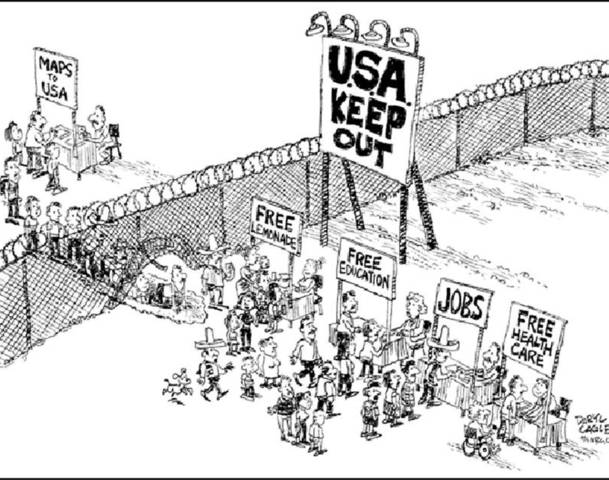
These xenophobic and racist attitudes towards immigrants, and illegal immigrants in particular, have been propelled by politicians who combine the post-9/11 terrorism fears and illegal immigration, two completely separate issues, into one. To give an example of this kind of “bundling”, Professor Kofas describes how politicians have taken advantage of the public’s fear of another event like 9/11 to elicit support for erecting a wall along the U.S.-Mexico border. The construction of this structure, which seems like the western hemisphere’s version of the Great Wall of China, would cost billions of tax payer dollars, yet of course, by playing on the taxpayers’ fears, even the most conservative taxpayers could see the “necessity” of spending that money. But the question is, how many terrorists even come through the U.S.-Mexican border? The vast majority of people trying to enter the U.S. through that channel are workers, looking for a means to support themselves and/or their family. Considering the state of the U.S. economy and the pessimistic forecast, perhaps those dollars can be used more effectively elsewhere.
Vicky Yau is a second year law student at UC Davis School of Law.
KJ
Posted in: