
ACLU Report: Border Patrol’s “Interior Enforcement” Records Show Systemic Abuse, Few Apprehensions
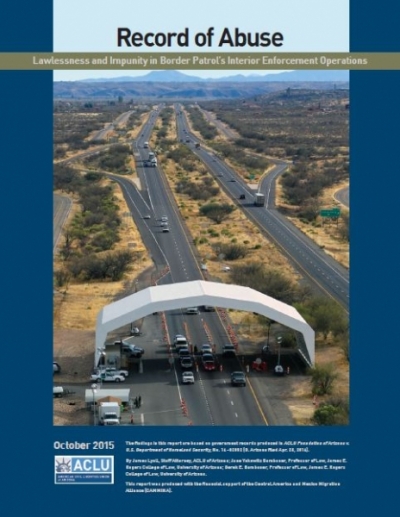
The ACLU of Arizona has released a report detailing widespread acts of abuse and impunity in U.S. Border Patrol’s interior checkpoint and “roving patrol” operations, most of which occur far from the border. Based on government records obtained through an ACLU Freedom of Information Act (FOIA) lawsuit, the report reveals a systemic lack of oversight and accountability for agents who violate motorists’ civil and constitutional rights on a dramatic scale.
The ACLU’s report, which was co-authored with two University of Arizona law professors (Jane and Derek Bambauer) includes the following key findings:
- Border Patrol’s records contain recurring examples of agents terrorizing motorists far into the interior of the country; detaining and searching innocent travelers after false alerts by service canines; threatening motorists with assault rifles and other weapons; destroying personal property; and interfering with attempts to video record agents. These abuse records substantially outnumber the annual complaint totals DHS oversight agencies disclosed to Congress.
- Border Patrol does not record stops of motorists that do not result in arrest, or false canine alerts that lead to searches of innocent suspects. Substantive investigations into civil rights violations are rare and almost never result in disciplinary consequences. Despite numerous reports of abuse and corruption, the records contain only one example of disciplinary action of any kind.
- Border Patrol’s own data undermines the agency’s public claims that checkpoints are efficient and effective: in 2013, Tucson Sector checkpoint apprehensions accounted for only 0.67 percent of the sector’s total apprehensions. The same year, Yuma Sector checkpoint arrests of U.S. citizens exceeded those of non-citizens by a factor of nearly eight (and in 2011, by a factor of eleven).
The report summarizes scores of civil rights complaints submitted to DHS oversight agencies that do not appear to have been properly investigated, including:
- A Border Patrol agent in Green Valley, Ariz., followed a store employee into a parking lot, approached the individual with a service revolver drawn, ordered him to his knees, and handcuffed him. When other employees approached, the agent yelled, “Stay away or I’ll shoot you.” After ten minutes, the agent removed the handcuffs, released the employee, and drove away.
- One complaint described multiple stops of the Tohono O’odham Community College school bus at the Highway 86 checkpoint, including one in which passengers were forced to disembark and submit to interrogation and searches of their personal effects before being released. Other records show Border Patrol monitoring Tohono O’odham community meetings and Know Your Rights events.
- A Border Patrol agent reported a supervisor at Border Patrol’s Naco Station instructed agents to “stop any vehicle on the US/Mexican border road that is open to the public.” The supervisor allegedly “didn’t care if it was the Chief of the Border Patrol and the agent conducted a high risk traffic stop … at gun point” because he “would then know they were doing their job.”
- The Nogales City Attorney’s Office reported racial profiling and abuse of authority after agents at the I-19 interior checkpoint relied on a claimed canine alert to detain and search the attorney. The complaint references a Deputy City Attorney detained and searched on other occasions on the basis of claimed or false canine alerts.
The records were obtained through a January 2014 FOIA request seeking information related to interior operations in Border Patrol’s Tucson and Yuma Sectors from 2011 to the present. After DHS failed to respond, the ACLU filed suit in April 2014. The FOIA request followed a series of complaints the ACLU submitted to DHS oversight agencies in 2013 and 2014 on behalf of Arizona motorists who reported abuse by Border Patrol agents at interior checkpoints and in roving patrol stops. Those complaints were not investigated and have not resulted in discipline for the agents involved.
The report includes several recommendations, including improved data collection, a prohibition on racial profiling, and enhanced oversight. The ACLU of Arizona is also calling on CBP’s new Internal Affairs head Matthew Klein to reopen investigations into the civil rights complaints described in the report.
The ACLU’s report is available here. Fernanda Santos of the New York Times reports on the ACLU findings in this article.
KJ