
Montana Supreme Court Unanimously Invalidates Montana Immigration Enforcment Law as Preempted by Federal Law
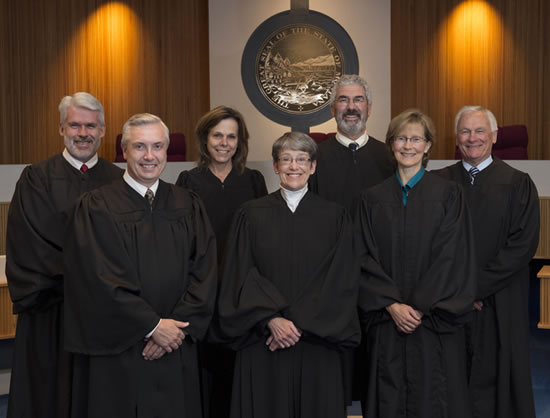
Photo courtesy of the Montana Supreme Court
Yesterday, the Montana Supreme Court issued a unanimous decision striking down the entirety of an immigration enforcement law, which was placed on the 2012 ballot by the Montana legislature and approved by 80% of voters. The law, known as LR-121, would have denied a wide variety of state services to so-called “illegal aliens,” including crime victim services, infant hearing screenings, and the ability to attend a public university. It would have also required that state agencies report these applicants to immigration authorities. The law defined “illegal aliens” so broadly that it included numerous Montanans who are in this country with valid legal status.
Before the law went into effect, the Montana Immigrant Justice Alliance (“MIJA”) challenged it as an unlawful state regulation of immigration that would have wrongly denied state services to non-citizens with valid immigration status.


MIJA was represented on a pro bono basis by attorneys Shahid Haque-Hausrath of the Border Crossing Law Firm, P.C., and Brian Miller of Morrison, Sherwood, Wilson, & Deola, PLLP.
In 2014, a district court granted summary judgment in MIJA’s favor, and found that most of LR-121 was unconstitutional. However, the district court allowed one provision, mandating reporting to immigration authorities, to stand. The State of Montana appealed the district court decision to the Montana Supreme Court. In its unanimous decision, the Montana Supreme Court went one step further than the district court and invalidated the reporting provision as well, rendering the entirety of the law unconstitutional.
The Montana Supreme Court noted that, although states have the power to deny certain state services to immigrants who are not lawfully present in the United States, the states lack the power to decide which immigrants are lawfully present in the U.S.. LR 121 encroaches on the federal government’s power to determine which immigrants are here lawfully, and it could deny benefits to immigrants who would be entitled to those benefits under federal law. Consequently, the Supreme Court found that LR 121 is preempted by federal law.
KJ