
2016 World Day against Trafficking in Persons
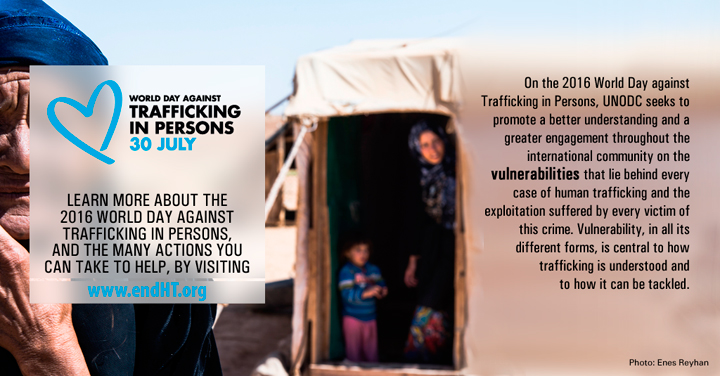
In 2013, the United Nations General Assembly designated the 30th of July as the World Day against Trafficking in Persons to raise awareness about the severity of human rights violations that trafficking victims endure and acknowledge that human trafficking is a crime that affects all countries in the world.
On the 2016 World Day against Trafficking in Persons, United Nations Office on Drugs and Crime seeks to promote a better understanding and a greater engagement throughout the international community on the vulnerabilities that lie behind every case of human trafficking and the exploitation suffered by every victim of this crime. Vulnerability, in all its different forms, is central to how trafficking is understood and to how it can be tackled.
Show your solidarity with victims of human trafficking: download the ‘how to’ for more details on getting involved, support the United Nations Voluntary Trust Fund for Victims of Human Trafficking and participate in the activities on 30 July, marking the World Day throughout the globe.
The International Organization for Migration (IOM), which has announced a campaign against human trafficking, has developed a global database to identify trends related to migration and human trafficking. IOM’s global data on human trafficking suggests that all countries are – to different degrees – countries of destination, transit and origin. It also shows that human trafficking is characterized by super-diversity, very much as recent global migration patterns are considered to be. This brings numerous challenges but also a common goal for countries to cooperate in a pragmatic way to fight human trafficking.
IOM is the lead agency in the protection and provision of assistance to victims of trafficking. It has the world’s largest database on victims of human trafficking. The data recorded by IOM is based on its direct assistance of victims by IOM missions working in the field globally. In the past year, IOM has improved its capacity to collect more and better victim data and it aims to provide wider, appropriate public access to information on human trafficking.
U.S. Immigration and Customs Enforcement has been tasked with policing human trafficking in the United States
KJ