
DC Circuit Rules for Production of IJs Names in Misconduct Cases
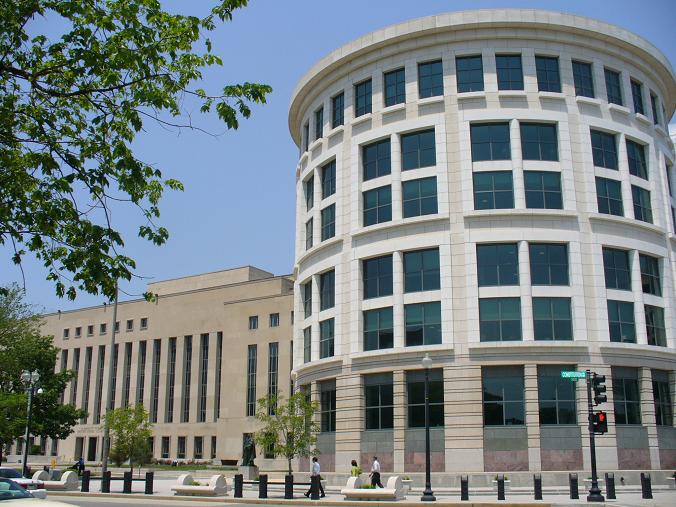
E. Barrett Prettyman U.S. Courthouse and William B. Bryant Annex
Josh Gerstein on Politico.com reports that in a Freedom of Information Act case involving records of misconduct allegations leveled at immigration judges. Here is the opinion.
The panel held that the identities of immigration judges accused of misconduct could not be categorically deleted from records made public under the Freedom of Information Act. The court also ruled that when producing email chains and similar records under FOIA, agencies cannot redact information solely on the basis that it appears to be nonresponsive to the subject of a request.
The finding that rejects across-the-board privacy deletions could make it easier to expose information about inappropriate actions by federal employees or perhaps even by people outside government.
Judge Sri Srinivasan said the blanket redaction of names ignored the fact that there might be good reasons for striking the transparency-privacy balance differently in different instances.
“Variations in the privacy and public interests at stake leave us unable to find, at least as a blanket matter, that the … balance tips in favor of withholding immigration judges’ names in all circumstances,” Srinivasan wrote in an opinion joined by judges Karen Henderson and Patricia Millett. “That is not to say, necessarily, that [the Justice Department’s Executive Office for Immigration Review] could not ultimately support redacting identifying information in all cases if its justifications for doing so were framed in a more targeted manner. That question is not before us, however. Because EOIR here sought to justify its withholding of immigration judges’ names in purely categorical, across-the-board terms, it has not carried its burden.”
The decision came on a lawsuit brought by the American Immigration Lawyers Association, which is investigating the system of discipline for immigration judges. In response to a FOIA request, the Justice Department turned over records regarding complaints and their resolution but removed the names of judges and substituted a code number.
Srinivasan said that action sold short the public’s interest in knowing how the judges were discharging their duties.
“Given the variety in types of complaints and circumstances of individual immigration judges, not every judge has the same privacy interests at stake and not every complaint would equally enlighten the public about ‘what their government is up to,’” Srinivasan wrote.
“The public interest likely would be more pronounced in the case of a sitting immigration judge, who continues to make decisions as an employee of the Department of Justice, than in the case of a former judge. Additionally, disclosing the name of an immigration judge subject to numerous and/or serious substantiated complaints might shed considerable light on matters of public interest, whereas disclosing the name of an immigration judge subject to a single, unsubstantiated complaint might not,” the appeals court judge added.
The second key aspect of Friday’s decision could help the public understand more about the context of government actions, but it could also slow down FOIA processing even further by pulling more extraneous issues into a request.
“Once an agency itself identifies a particular document or collection of material — such as a chain of emails — as a responsive ‘record,’ the only information the agency may redact from that record is that falling within one of the statutory exemptions,” Srinivasan wrote.
The judge acknowledged that it’s sometimes difficult to say what qualifies as an individual record, but he said immigration officials had not struck the right balance when they deemed individual sentences in a single email to be “nonresponsive.”
“We find it difficult to believe that any reasonable understanding of a ‘record’ would permit withholding an individual sentence within a paragraph within an email on the ground that the sentence alone could be conceived of as a distinct, non-responsive ‘record,’” Srinivasan wrote.
KJ
Read more: http://www.politico.com/blogs/under-the-radar/2016/07/freedom-of-information-immigration-judges-226437#ixzz4FtSFL8Va
Follow us: @politico on Twitter | Politico on Facebook