
From the Bookshelves: Kathleen Newland, All at Sea: The Policy Challenges of Rescue, Interception, and Long-Term Response to Maritime Migration
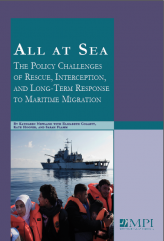
A new Migration Policy Institute (MPI) book by Kathleen Newland, with contributions from Elizabeth Collett, Kate Hooper and Sarah Flamm, analyzes global policy responses at regional, national and international levels, and provides suggestions for managing the “wicked problem” of unauthorized maritime migration.
The book, All at Sea: The Policy Challenges of Rescue, Interception, and Long-Term Response to Maritime Migration, offers five case studies of global hotspots for irregular maritime migration: the Mediterranean, the Bay of Bengal/Andaman Sea, the Gulf of Aden/Red Sea, the Caribbean and the seas surrounding Australia.
Although policy discussions about maritime migration once typically focused on rescue, those today are more likely to be framed in terms of interception and deterrence. The current, central dilemma is how to reconcile concerns over border protection, national security and organized crime with international legal obligations and regional or global burden-sharing.
“Unauthorized maritime migration is everywhere characterized by complexity,” writes Newland, an MPI senior fellow. “The multiplicity of state- and non-state actors, the mixed flows of refugees and non-refugees, the overlapping and sometimes contradictory legal rulings, the fluctuating state policies, the secondary movements of people from countries of first asylum and the constantly shifting sources, routes and destinations—all these factors and more make maritime migration an extremely difficult issue to resolve.”
She and her co-authors suggest that better collection and sharing of data, better evidence and analysis of the causes of maritime migration and monitoring of the impact of policies are necessary for policymakers to arrive at well-informed decisions and understand whether their actions are having the intended results. One-dimensional responses are unlikely to be effective in addressing the whole phenomenon of maritime migration and have been seen to produce unintended, and often unwelcome, consequences. Governments may choose to live with these. Alternatively, they may adopt responses that are tactically flexible and capable of adapting to changing circumstances while remaining strategically anchored in rule of law, the imperative of safety and respect for human dignity.
For more on the book, visit here.
KJ