
Migrant Deaths Worldwide Top 7,100 – Over Half in the Mediterranean
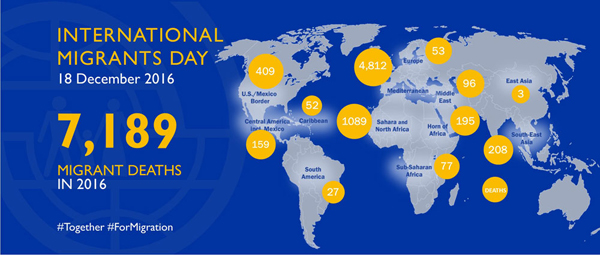
The International Organization for Migration is reporting today (16/12) 7,189 migrants and refugees have died or remain missing on world migratory routes. This is the highest yearly number IOM has ever recorded, and represents an average of 20 deaths per day, suggesting the deaths of another 200-300 men, women and children well may be recorded worldwide before 2016 comes to an end.
This week’s number of migrant deaths recorded globally in 2016 was compiled by IOM’s Missing Migrants Project and Global Migration Data Analysis Centre. By comparison, total fatalities compiled by IOM in 2014 (5,267) and 2015 (5,740) both fell hundreds of victims short of the 6,000 mark, a figure that was surpassed this year before the end of November. As in the previous two years, the number of deaths on the three principal Mediterranean routes linking North Africa and the Middle East with Europe accounted for over 60 percent of all deaths worldwide.
IOM reports the number of migrants recorded as dead or missing and presumed dead – appears to be rising across all regions, including the Mediterranean, Northern and Southern Africa, as well as in Central America and in the United States-Mexico border region. Each already has surpassed those recorded in these regions through all of 2015, according to recent IOM data.
For Eastern and Northern Africa, the Missing Migrants Project relies on the work of the Regional Mixed Migration Secretariat’s (“RMMS”) Mixed Migration Monitoring Mechanism Initiative (“4Mi”), which surveys migrants from Eritrea, Ethiopia, Djibouti and Somalia. Data collection monitors in migration hubs in 13 countries across Europe and Africa ask migrants in transit a variety of questions to do with their journey, including whether they have witnessed the deaths of other migrants along the way.
The findings of 4Mi’s survey indicates that over 700 migrants from Eritrea, Ethiopia, Djibouti and Somalia have died during migration in 2016. These deaths are due to vehicle accidents, violent attacks and other harm associated with a lack of access to medicines, shelter, food and water during their journey. The majority of these deaths occurred in Sudan, Egypt and Libya. It is likely that many more deaths go unrecorded by any official government or humanitarian aid agency.
But they often are recorded by migrants themselves. Among IOM’s most important sources of information are testimonies of other migrants, who are videotaping these daily tragedies on cell phones, or alerting family members and friends of the deceased via Facebook posts and other social media. Mining these veins of information IOM’s Missing Migrants team this year discovered hundreds of victims in Latin America, off the coast of Yemen or on lonely highways across Africa.
KJ