
Models, Medivacs, Moguls, and More
My first professor-in-action shot! Photo by Connor Murphy/UND Today.
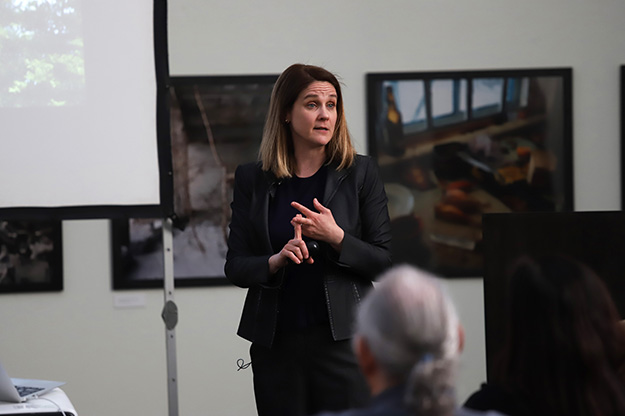
On Wednesday, I gave a lecture to the University of North Dakota and Grand Forks communities — Models, Medivacs, Moguls, and More: Finding the Curious in Immigration Law. UND has a write-up of the talk here.
It was a unique opportunity to present select portions of my scholarship as as a cohesive whole. I’ve written before in praise of written scholarship summaries such as the Virginia Journal’s write up on Kerry Abrams. I tried to emulate that approach in developing my talk.
I started with what drew me to immigration — a quest to understand my own history. Seven of my eight great-grandparents all came to the United States in a 15-year window between 1875 and 1910. They hailed from Poland, Russia, Sweden, and Germany. Each benefited from the lack of immigration quotas and quality controls at the time. One was fleeing conscription into the Russian Army, others came to join family members already here — stories that resonate today with the debate over “chain migration” and questions of what we owe to those fleeing violence.
In terms of scholarship, I discussed:
- My work regarding the Disney visa, documenting the history of the Q visa — legislation written by and for Walt Disney World in order to staff the World Showcase at Epcot. It’s a fascinating tale of lobbying and advocacy that I’m revisiting shortly in a NYU Journal of Law & Liberty symposium issue (links coming soon).
- My work on foreign fashion models, which documents the history of the H1B3 visa for fashion models and discusses the failed legislative proposals to move fashion models out of the H1B sphere and into the P visa. The piece also talks about how it might be possible to use the visa for foreign fashion models to address the public health consequences of the modeling industry by restricting its availability on the basis of age and BMI.
- My work on proposals to fix the post-2006 housing crisis with a visa for home buyers. It’s a story of legislation with a sound economic rationale (surplus homes can’t be shipped overseas, but people can be invited from overseas to fill them), and it’s also an example of trying to use immigration law to fix a non-labor-based economic problem.
- A Citizenship Market, which will be published by the Illinois Law Review this year. In it, I explore a thought experiment about whether whether individuals should be permitted to swap citizenships with each other.
- The private expulsion of uninsured noncitizens by U.S. hospitals – a practice known as “medical repatriation.”
- An empirical study of international students at the University of North Dakota that I conducted for a contribution to an upcoming Lewis & Clark Law Review symposium on Trump’s executive orders. (It will be held on Friday, March 9, if you’re in the Portland, Oregon area.) Between March and October 2017, I interviewed 45 UND students to discuss the anxieties they had about studying in this country and the opportunities that drew them to pursue their education here. (One interesting tidbit: They were perhaps as worried about guns in the U.S. as they were about being denied re-entry by the CBP.)
It was a tremendous honor to share my passion for immigration with a diverse audience and to have the opportunity to take a broader look at my own work.
-KitJ