
Hispanic Share of US Labor Force up 8-Fold 1950-2016
The Federal Reserve Bank of St. Louis released at report on the Hispanic work force. The “key takeaways”:
- Hispanics are a growing share of the U.S. workforce. Yet they are more likely to work in lower-skill occupations than non-Hispanics.
- Data show that the education level of Hispanic workers lags behind that of non-Hispanic workers. This may explain the disparity in occupations.
- The country’s aggregate productivity would improve if Hispanics could develop their talent and skills

Rural Migration News summarizes the report as follows:
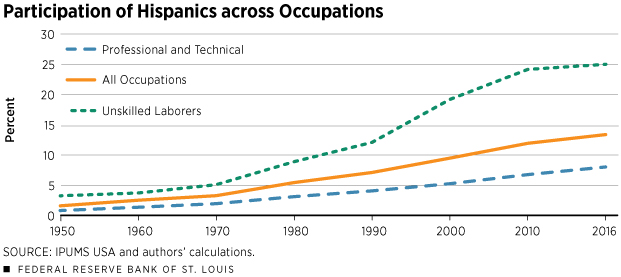
The share of Hispanics in the US labor force increased eight-fold between 1970 and 2016, from less than two percent to over 13 percent. Growth was fastest for farmers and farm laborers: the Hispanic share of workers in this occupation rose almost 14 times, from less than two percent to 25 percent.
The share of Hispanics in low-skill occupations rose fastest, which helps to explain why the earnings of Hispanics relative to non-Hispanics fell from 85 percent to 70 percent between 1950 and 2016.
One reason for the widening wage gap between Hispanic and non-Hispanic workers is the gap in education levels. Many Hispanics do not complete high school, almost 40 percent in 2016, compared with 15 percent of non-Hispanics. A quarter of non-Hispanics completed college, compared with less than 10 percent of Hispanics. Among Hispanics who completed college, a higher share are women than men.
The points below are from the St. Lous Fed:
- The share of Hispanics in the US labor force increased 8-fold between 1950 and 2016
- The share of Hispanics in low-skill occupations rose fastest
- The relative earnings of Hispanics fell as their share of the labor force increased
- Some 40 percent of Hispanics in 2016 did not complete high school
KJ