
More military rejected for US citizenship than civilians
According to the Miami Herald, immigrants in the military are getting denied U.S. citizenship at higher rates than civilians. According to the most recent USCIS data available, the agency denied 16.6 percent of military applications for citizenship, compared to an 11.2 percent civilian denial rate in the first quarter of fiscal year 2019, a period that covers October to December 2018. This trend reflects the impact of stricter Trump administration immigration policies on service members.
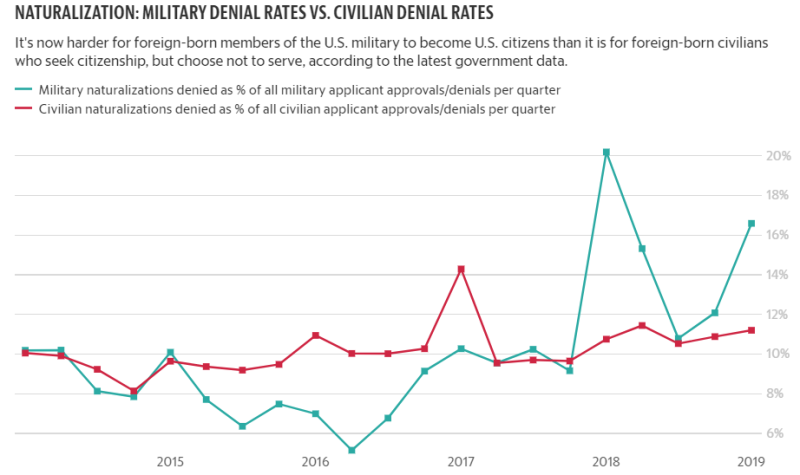
According to the same data, the actual number of service members even applying for U.S. citizenship has also plummeted since President Donald Trump took office, the U.S. Citizenship and Immigration Services reported in its quarterly naturalization statistics. Partly the lower applications may be the result of people being disheartened by the immigration climate, as the article hypothesizes. But as Margaret Stock has explained in interviews, public statements, and this article, it might also be that Trump administration policy changes at the DoD have made it virtually impossible to get the necessary approvals to apply for citizenship. Previously, immigrant enlistees previously could join basic training once a background investigation had been initiated, and they could become eligible to start seeking citizenship after one day of military service. Under the new policy, enlistees do not go to basic training until their background investigation is complete, and they have to complete basic training and 180 days of service before they can seek citizenship. The Trump administration in 2017 announced major changes to the way the Pentagon would vet and clear foreign-born recruits and other overall changes to when a service member would qualify for naturalization, including the need to obtain wet signatures from higher ups and closures of naturalization offices at some of its basic training locations.
The cumulative effect of the lower number of applications, longer waits, and higher denials is a reversal of the U.S. tradition of honoring immigrants who serve in the military as model citizens. Retired Army Major General is quoted in the military as saying, “The U.S. has had a long-standing tradition of immigrants come to the U.S. and have military service provide a path to citizenship.” He continues: “To have this turnaround, where they are actually taking a back seat to the civilian population strikes me as a bizarre turn of events.” Indeed. More historical and comparative research on military naturalization is provided in Earned Citizenship, a book by Michael Sullivan featured in an ImmigrationProf Blog post last week, and Jus Meritum a book chapter by Grace Cho and Cara Wong that I routinely assign in my Citizenship seminar examining competing justifications for citizenship acquisition.
– MHC