Article of the Day: Pedagogy of Prefiguration, by Sameer Ashar
By Guest Blogger Dulce S. Rodas, UC Law San Francisco (formerly UC Hastings) JD ’23
The pedagogical framework of law school undervalues the power of narrative and coalition building. Law students and attorneys have the legal training to help address legal issues but often lack a nuanced understanding of the ways in which systems of oppression function and replicate. The typical first-year curriculum does not encourage law students to dare to envision the law beyond its status quo. The fight for immigrants’ and workers’ rights needs law students and attorneys who engage in advocacy that cultivates innovation and the ability to “conceive of the law as it might be.” UC Irvine Law Professor Sameer Ashar’s recent article, Pedagogy of Prefiguration, 132 Yale L. J. Forum (2023), provides a glimmer of hope that positive transformation of the orthodox legal pedagogy is possible.
I am currently a third-year law student, months away from becoming an immigrants’ rights attorney. I grew up in a mixed-status immigrant family during the aftermath of California’s Proposition 187 and the enactment of the Illegal Immigration Reform and Immigration Responsibility Act (IIRIRA), which together criminalized undocumented immigrants and framed them as “illegal” in the public discourse. My lived experience, as the daughter of working-class immigrants, led me to believe that long-term systemic change is only possible through community-based movement lawyering that focuses on empowering the people most impacted by systems of oppression and injustice.
My moment of political awakening was during the massive marches in 2006, when millions of immigrants and allies gathered throughout the U.S. to protest against proposed anti-immigrant legislation. I vividly remember attending the march in Los Angeles with my parents. Every year around May 1st, otherwise known as “May Day” or International Workers’ Day, I think about the things that advocates can learn from the social movements that fought against California Proposition 187 and H.R. 4437, and the movements led by DACA recipients and immigrant youth. How can we tailor these advocacy efforts and social movements to the needs of immigrant workers today? Professor Ashar’s article is a clear reminder that law students and attorneys should work with social movements to create justice systems rooted in humanity that address the needs of those most impacted.
I came to law school to use my lived experience and education to serve my community. As advocates we cannot serve our communities if we ignore the realities that they face: racism, xenophobia, and capitalism, to name a few. Professor Ashar directs the Workers, Law, and Organizing Clinic (WLO) at the University of California, Irvine School of Law. He and his clinical students represented former employees of a pistachio processing plant in Wasco, California in their retaliation case. They deliberately highlighted the racial and economic vulnerabilities of the Latinx immigrant workers during COVID-19, instead of just focusing on the employer’s violations of California retaliation laws. At a speaking event, Professor Ashar explained that in defining the problem as wage theft or retaliation in violation of public policy, instead of racialized wage extraction, we would not get the kind of responses needed to address the underlying issues at stake.
Throughout my lifetime, there have been many failed promises of immigration reform and pathways to lawful immigration status, including the proposed Deferred Action for Parents of American and Lawful Permanent Residents (DAPA) and the immigration provisions of the Build Back Better Act. Nevertheless, I still have hope that humane immigration laws are possible. My optimism stems from my family and my community, but it also comes from other advocates reframing the immigrant narrative and reimagining what it means to be a legal advocate. Activist-scholars like Professor Ashar give me hope that legal education can change for the better. When it does, more students with a deep knowledge and intimate experience with racialized subordination will pursue a legal education. They too will help transform the existing pedagogy and creatively explore avenues for systemic change through advocacy that goes beyond the courts.
Here is the abstract for the article:
As our social problems deepen and movements rise to meet those challenges, lawyers must expand their repertoire to support transformative visions. Social-movement organizations are not only developing policy platforms, but also experimenting with legal advocacy and institutional development that meet human needs and strive to resist liberal cooption. Movements are engaged in prefigurative thinking, outside of the terms and constraints of our present late-neoliberal moment of global climate emergency and democratic crisis. Building on the work of Davina Cooper on everyday utopias, the Marxist and anarchist theorists of prefigurative politics, and Stefano Harney and Fred Moten on the undercommons, this Essay asks how we may teach ourselves—lawyers and law students—to work with social-movement organizations on projects that prefigure utopian social arrangements. Is utopian imagination antithetical to training for legal practice? How can we help extend utopian imagination to the core social problems on which we work in clinical legal education? Along with several cautionary notes, this Essay suggests three methods with which to experiment: social analysis, radical imagination, and dialogical relationship with collaborators.
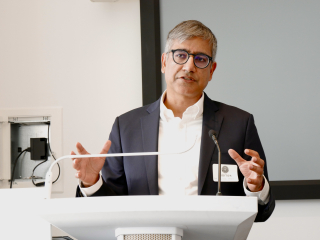
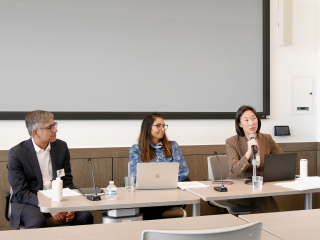
Here are photos from the RICE Colloquium at UC Law San Francisco where Prof. Ashar presented his work, in conversation with Prof. Veena Dubal and Prof. Ming H. Chen: