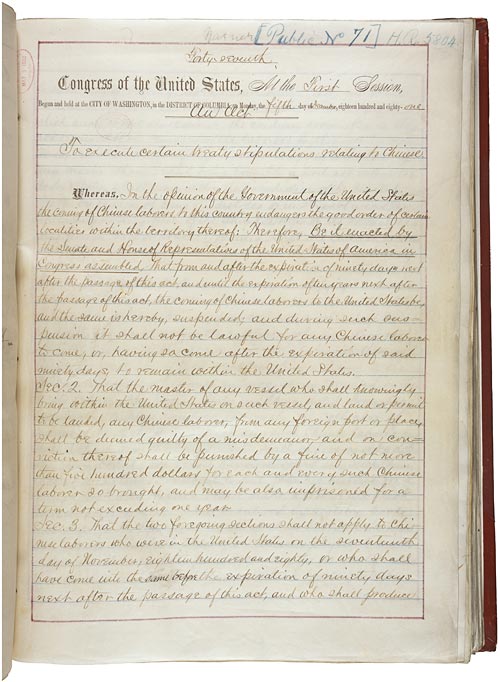
Chinese Exclusion Act
Today marks the 80th anniversary of the repeal of the Chinese Exclusion Act of 1882, one of several discriminatory federal laws that expressly targeted Chinese immigrants and paved the way for further policies restricting immigration from Asia. The law prohibited Chinese laborers from immigrating to the United States. Non-laborers seeking entry were required to obtain special certification. Chinese who had already entered the U.S. also faced new requirements should they leave the US and seek re-entry. The laws arose in response to xenophobia and a sense of economic threat following the importation of Chinese labor for the construction of the transcontinental railroad. The law is infamous as one of a few times that Congress enacted explicitly race-based exclusion. It was repealed in 1943, although national origin quotas restricting Chinese immigration remained intact until 1965. A brief history of the act appears on the website for the Library of Congress, NARA, and the Angel Island Immigration Station. Scholarly treatments issue from Mae Ngai, Erika Lee, and legal scholars of Chae Chan Ping and other immigration landmark cases.
On December 18, the occassion of repeal was commemorated in a statement by President Joe Biden and his US Trade Representative Katherine Tai.
MHC