
DHS v. DVD
As Kevin has already noted, the US Supreme Court issued a decision in the DHS v. DVD litigation yesterday.
I think it’s good to start with a bit of a refresher as to how we got here. The D.V.D. case was brought as a class action dispute in the U.S. District Court for the District of Massachusetts. The complaint was filed on March 23, 2025. Here is paragraph 1 of that complaint:
Plaintiffs and proposed class members are noncitizens with final removal orders resulting from proceedings in which they have been notified that they could be deported to a designated country of removal (usually their country of origin) and, in some cases, an alternative country of removal (usually a country of which they are a citizen or in which they hold status) and had an opportunity to contest removal to the designated country based on a claim of fear. They bring this class action to challenge the policy or practice of the Department of Homeland Security (DHS) of deporting, or seeking to deport, them to a third country – a country never designated for removal – without first providing them with notice or opportunity to contest removal on the basis that they have a fear of persecution, torture, and even death if deported to that third country.
Five days after the filing of this complaint, U.S. District Court Judge Brian E. Murphy issued a temporary restraining order enjoining
Removing any individual subject to a final order of removal from the United States to a third country, i.e., a country other than the country designated for removal in immigration proceedings, UNLESS and UNTIL Defendants provide that individual, and their respective immigration counsel, if any, with written notice of the third country to where they may be removed, and UNTIL Defendants provide a meaningful opportunity for that individual to submit an application for CAT protection to the immigration court, and if any such application is filed, UNTIL that individual receives a final agency decision on any such application.
A preliminary injunction followed on April 18 and that injunction, in turn, was amended on April 30 and thereafter “clarified” on May 7.
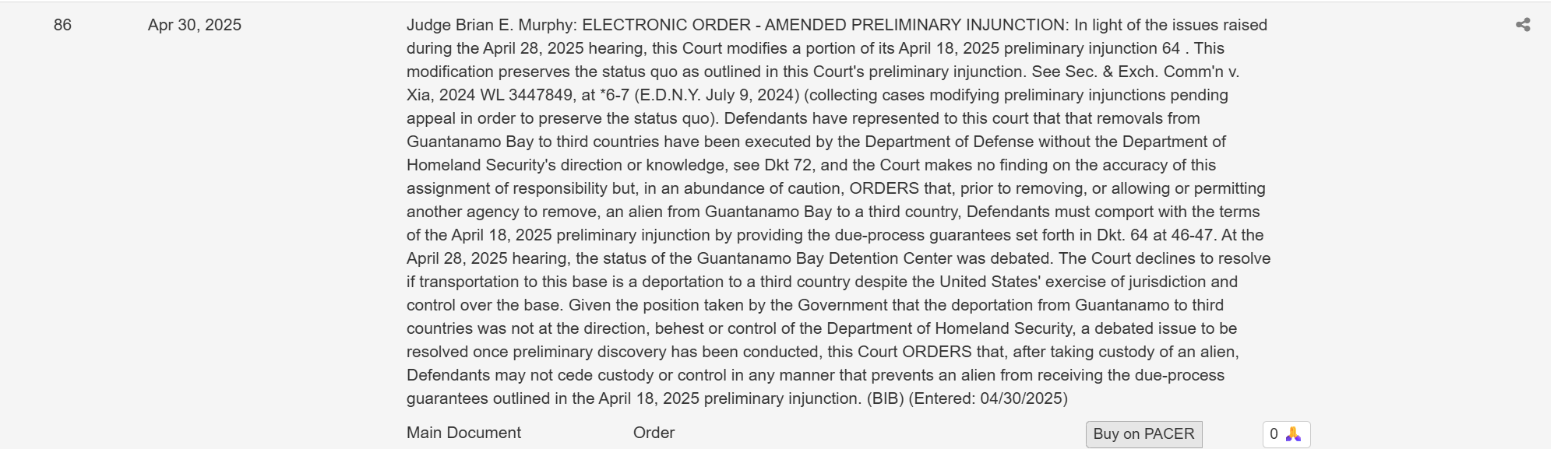
Meanwhile, the case was appealed to the U.S. Court of Appeals for the First Circuit where the government sought to stay the preliminary injunction pending the appeal. On May 16, the appellate court denied the motion to stay due to “the government not having met the standard for the relief sought.”
The government then brought their request for a stay to the U.S. Supreme Court on May 27. It is that application that the court ruled on yesterday.
Here’s the thing. The Court’s decision is just one paragraph in length. Here’s the full statement:
The application for stay presented to JUSTICE JACKSON and by her referred to the Court is granted. The April 18, 2025, preliminary injunction of the United States District Court for the District of Massachusetts, case No. 25–cv– 10676, is stayed pending the disposition of the appeal in the United States Court of Appeals for the First Circuit and disposition of a petition for a writ of certiorari, if such writ is timely sought. Should certiorari be denied, this stay shall terminate automatically. In the event certiorari is granted, the stay shall terminate upon the sending down of the judgment of the Court.
The one paragraph has no stated author, though we can infer the author is not Justice Sotomayor, Justice Kagan, or Justice Jackson given that Sotomayor penned a multi-page dissent that Kagan and Jackson joined.
What all does this mean? Staying the PI pending appeal in the First Circuit means that the government can remove noncitizens to third countries while simultaneously fighting in court that it is allowed to do so (rather than being prevented from removing noncitizens to third countries while arguing in court for the right to do so).
If you’re worried about what the government will do in the meantime, don’t forget that DHS Secretary Kristi Noem has issued guidance on the topic such that
- where the U.S. has received “diplomatic assurances” that extra-territorially housed noncitizens “will not be persecuted or tortured” by that country, and “if the Department of State believes those assurances to be credible,” then the noncitizen “may” be removed to that third country “without the need for further procedures.”
- where the U.S. has NOT received such diplomatic assurances, or has received them but the State Department does not find the received assurances credible, DHS can STILL remove the noncitizen to that country so long as the agency “inform[s]” the noncitizen of their removal to that nation. If the affected noncitizen expresses—unprompted—“fear” of removal to that country, they will be referred to USCIS to determine whether removal to that country might violate the Convention Against Torture.
-KitJ